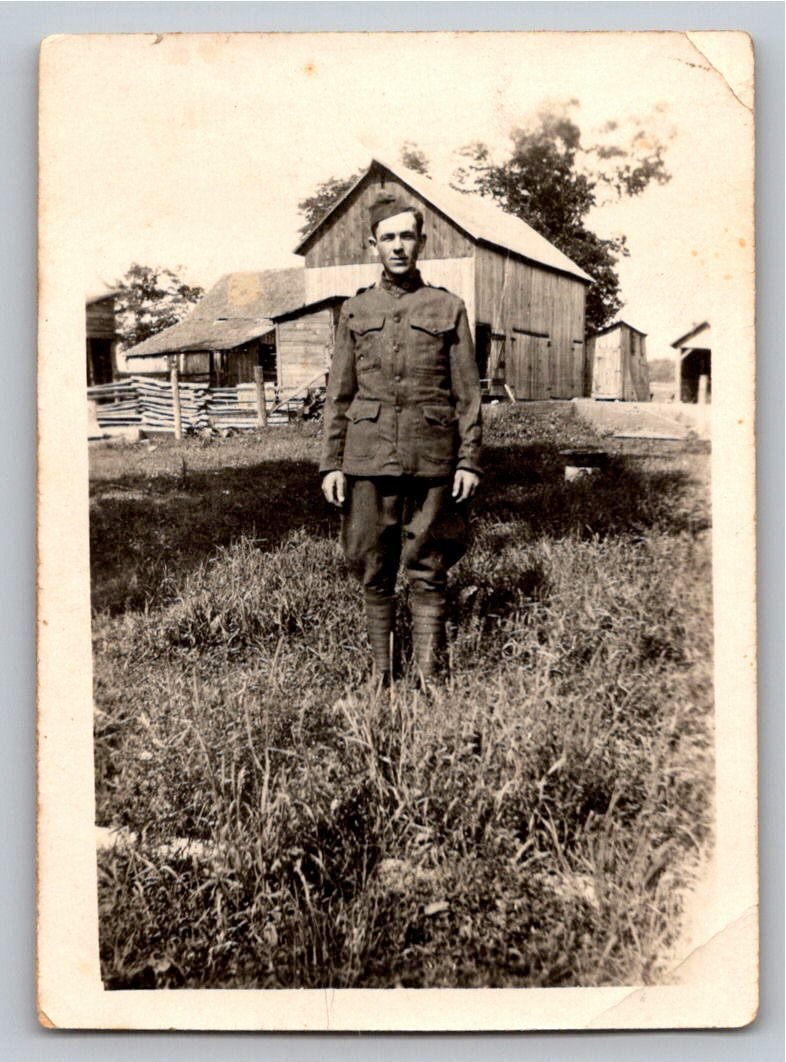
1918 WWI US Army Doughboy Soldier Uniform Barn Snapshot Photo
📸 Click any thumbnail to inspect Front, Back & Angles (2 Photos)
🔗 Embed / Cite This Archival Image (Free with Attribution)Get HTML Code
© USA RESELL. Bloggers, historians, and website owners may embed this image for free by copying the HTML code below (which includes the required credit link back to this page):
USA RESELL is a living historical archive. Because original artifacts are one-of-a-kind and source records change rapidly, use the button above to check live marketplace availability or locate surviving examples. As an eBay Partner, we may earn a commission on qualifying purchases.
Item Specifications
- City: Unspecified
- Country: United States
- Era: World War I (1914-1918)
- Subject: Doughboy Soldier Military Uniform Farm
- Theme: Militaria Americana
- Year of Production: 1918
- Category: Vintage Photography
- Format / Type: Snapshots
Historical Context & Overview
Visual & Historical Overview: A Doughboy on the Family Farm
Standing upright at attention amidst the overgrown grasses of a rural homestead, the young American soldier portrayed in this original Great War photograph embodies the quintessence of the U.S. Army Doughboy. Captured in sharp black-and-white tonal contrast, he is outfitted in the complete standard issue uniform of the American Expeditionary Forces (AEF). His high-collar service coat features regulation flap pockets, tailored shoulders, and a snug collar, complemented by fitted riding breeches, tightly spiral-wound canvas puttees wrapping the shins, and sturdy leather service shoes. Perched neatly atop his head is the iconic overseas side cap, a style adopted widely by troops serving abroad and preparing for departure.
The backdrop provides a striking architectural and cultural contrast to the soldier’s strict military attire. Looming directly behind him is a substantial, weathered timber barn with vertical plank siding, accompanied by outbuildings, an open-sided shed, a stacked split-rail fence, and a distant outhouse. The rustic pastoral surroundings firmly anchor this portrait to the American homefront during the mobilization years of 1917 to 1919. It evokes the powerful narrative of agrarian youth called away from peaceful agricultural pursuits to join the mechanized struggle on European battlefields, paused here for a family portrait either before leaving for training or upon returning home.
Personal Inscription and Rural Vernacular Context
On the reverse side of this original snapshot, an intimate handwritten notation in vintage fountain pen script reads simply: "Uncle Jim." This minimal yet deeply personal inscription transforms an anonymous military portrait into a poignant family keepsake. During the Great War, millions of young men from small towns and farming communities enlisted or were drafted into the armed forces. Families routinely relied on portable Kodak folding cameras to capture farewell or homecoming likenesses, preserving the memory of sons and uncles in uniform against the backdrop of their family farms.
Vernacular military photography from this era possesses a candid authenticity rarely achieved in stiff commercial studio portraits. Rather than posed against artificial painted canvas backdrops with staged props, "Uncle Jim" stands firmly on familiar soil. The direct sunlight accentuates the texture of the woolen uniform fabric, the individual boards of the rustic barns, and the wild grasses underfoot, creating an enduring historical document of early twentieth-century American life during wartime.
Physical Characteristics, Technique, and Collector Value
This original snapshot is rendered as a traditional gelatin-silver print on vintage photographic paper stock, measuring approximately 2.3 by 3.2 inches. It retains narrow white borders characteristic of period contact prints and personal snapshot cameras of the 1910s. The photographic emulsion exhibits remarkable clarity, preserving crisp focus across the subject’s facial features, pocket flaps, buttons, and puttee wraps, balanced by rich sepia-toned greys and warm highlight areas.
In terms of condition, the print remains in good vintage standing, exhibiting the gentle physical evidence of more than a century of careful handling. Minor corner softening and subtle surface creasing are visible near the lower edges, accompanied by natural age toning and slight scattered foxing across the blank reverse. For collectors of World War I militaria, early American photography, and vernacular rural portraiture, this snapshot serves as a touching and well-preserved artifact of the Great War generation.