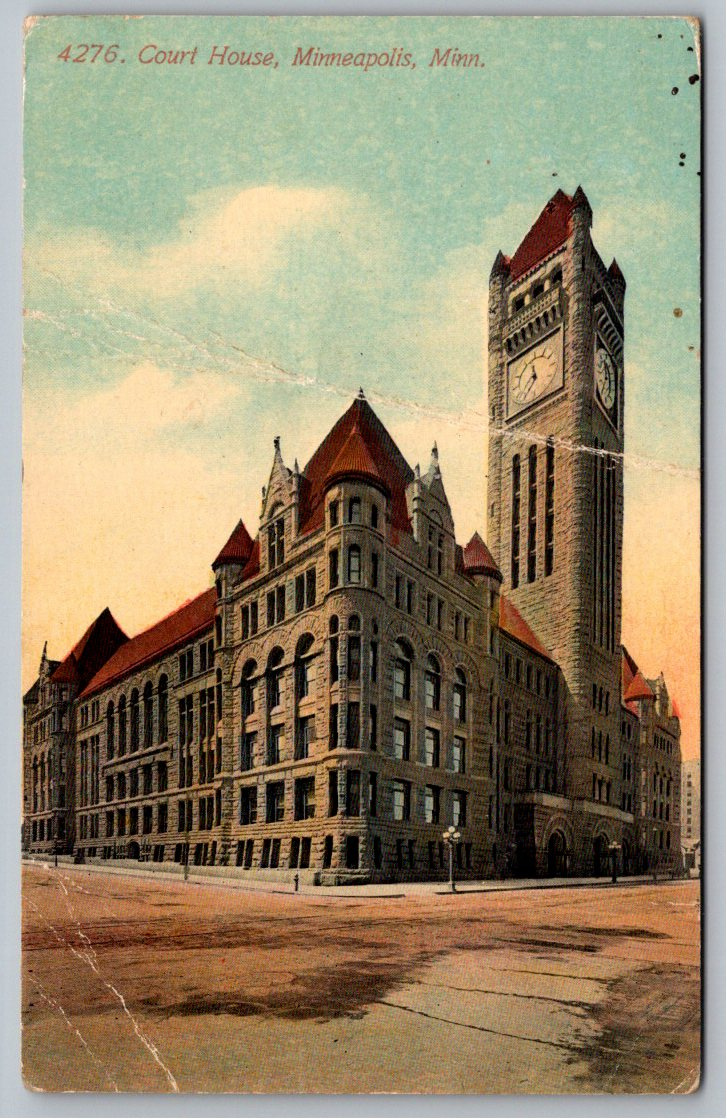
Antique 1908 Minneapolis Court House Divided Back Acmegraph
📸 Click any thumbnail to inspect Front, Back & Angles (2 Photos)
As an eBay Partner, we may earn a commission if you make a purchase.
Item Specifications
- Era: Divided Back (1907–1915)
- Year: c. 1908
- Publisher: The Acmegraph Co.
- Photographer: C. J. Hibbard & Co.
- Location: Minneapolis, Minnesota
- Subject: Minneapolis City Hall & Courthouse
- Category: Postcards & Ephemera
- Format / Type: Vintage Postcards
Looking for Modern Alternatives?
Explore top-rated, modern Postcards & Ephemera and related historical accessories on Amazon.
Shop Postcards & Ephemera on Amazon →As an Amazon Associate, we earn from qualifying purchases.
Historical Context & Overview
At the turn of the twentieth century, Minneapolis was rapidly transforming from a frontier mill town into a bustling Midwestern metropolis. Nothing captured this civic ambition quite like the Minneapolis City Hall and Hennepin County Courthouse. Commissioned in the late 1880s and completed in 1906, this monumental Richardsonian Romanesque structure served as a soaring statement of prosperity, power, and architectural refinement. This early antique postcard, produced around 1908 by The Acmegraph Company of Chicago, showcases the landmark in all its original glory.
Monumental Richardsonian Romanesque Architecture
Designed by the local architectural firm Long and Kees, the courthouse was heavily inspired by Henry Hobson Richardson’s masterpiece, the Allegheny County Courthouse in Pittsburgh. Built using massive blocks of pink granite quarried near Ortonville, Minnesota, the building features rich rusticated masonry, grand arched entranceways, and intricate stone carvings. At the time of its completion, its central clock tower rose over 345 feet above street level, housing a massive clock face larger than that of Big Ben in London. For decades, it stood as the tallest building in Minneapolis, dominating the city's nascent skyline.
The color lithograph featured on this postcard highlights the striking contrast between the deep red roof tiles and the multi-toned granite facade. The elevated corner angle emphasizes the towering verticality of the clock tower alongside the detailed, arched window bays lining the street level.
A Collaboration of Pioneer Photographers and Publishers
What makes this specific postcard particularly notable for ephemera collectors is its publisher and photographer attributions. Printed on the reverse, the card acknowledges photography by C. J. Hibbard & Co., one of the premier commercial photography studios active in Minneapolis during the late 19th and early 20th centuries. Hibbard was renowned for capturing the expanding urban landscape of Minnesota with exceptional clarity and artistic framing.
The image was published by The Acmegraph Co. of Chicago, a well-regarded producer of colorized view cards during the Golden Age of Postcards. Utilizing advanced multi-color lithographic processes, Acmegraph brought vivid hues to early photographic prints, making civic landmarks vibrant and appealing to tourists and locals alike.
The Golden Age of Postcards and the Divided Back Era
This postcard belongs to the "Divided Back" era of postcard history, which began in March 1907 when the United States Post Office allowed senders to write messages on the back alongside the recipient's address. Prior to this innovation, notes could only be written on the front margin of the image. The back of this card features the characteristic stylized "Post Card" lettering in crimson ink, along with the standard single-cent stamp box reserved for domestic postage.
Preserved in unposted condition, this card offers a clean window into Minnesota's architectural heritage over a century ago. Whether you are an avid collector of Twin Cities ephemera, an architecture enthusiast, or a historian studying turn-of-the-century urban growth, this vintage postcard remains a compelling artifact of Minneapolis history.