1930s Norris Dam Tennessee Grist Mill Grinding Stones Vintage
📸 Click any thumbnail to inspect Front, Back & Angles (2 Photos)
As an eBay Partner, we may earn a commission if you make a purchase.
Item Specifications
- Era: 1930s
- Location: Norris Dam, Tennessee
- Subject: Grist Mill & Grinding Stones
- Stamp Box: EKC
- Originality: Original Vintage
- Publisher: Real Photo Publisher
- Category: Postcards & Ephemera
- Format / Type: Real Photo Postcards (RPPC)
Looking for Modern Alternatives?
Explore top-rated, modern Postcards & Ephemera and related historical accessories on Amazon.
Shop Postcards & Ephemera on Amazon →As an Amazon Associate, we earn from qualifying purchases.
Historical Context & Overview
Preserving Appalachian Milling Heritage: The Norris Dam Grist Mill
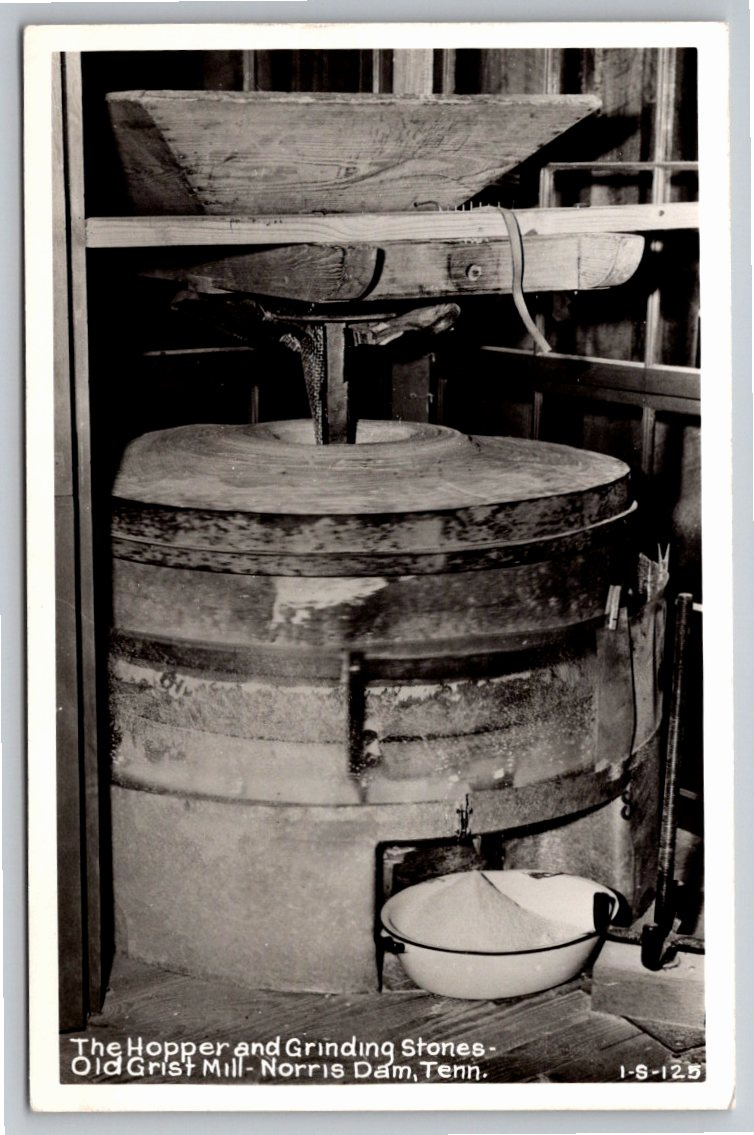
During the Great Depression, the establishment of the Tennessee Valley Authority (TVA) forever altered the landscape, economy, and culture of East Tennessee. As the construction of Norris Dam reshaped the Clinch River valley in the mid-1930s, TVA planners and local historians made concerted efforts to document and preserve traditional regional architecture and folkways. Among these treasured structures was the historic grist mill—a cornerstone of 19th-century rural life in the Appalachian Mountains. This rare real photo postcard (RPPC) offers an intimate, highly detailed interior look at the mill's mechanical heart: the timber hopper and massive grinding stones.
Anatomy of the Millstone: Mechanics of a Bygone Era
Traditional grist mills relied on ingenious mechanical engineering powered by wooden waterwheels or hydraulic turbines. The photograph meticulously captures the wooden hopper suspended above the enclosed millstones. Grain was poured directly into the hopper, which steadily channeled kernels down into the eye of the upper stone, traditionally known as the "runner stone." As the runner stone rotated atop the stationary "bedstone" underneath, precise spiral grooves chiseled into the rock faces sheared and ground the grain into fine flour or cornmeal.
Visible at the base of the stone shroud in this image is an enamel basin catching fresh meal, illustrating the direct, tactile nature of early American grain processing. For generations, grist mills served as vital economic infrastructure for local farmers, as well as essential social hubs where community members gathered to trade news and tell stories while awaiting their flour.
Collector Significance and TVA-Era Photographic Artifacts
Real photo postcards from the 1930s offer an exceptional, unfiltered window into American regional history. Printed directly onto silver halide photo paper—identifiable by the classic EKC stamp box on the reverse side—this card delivers rich depth, crisp contrast, and texture that mass-produced printed lithographs could not replicate. From the visible grain of the hand-hewn timbers to the flour-dusted rim of the stone housing, this vintage RPPC is a valuable historical document for collectors of East Tennessee history, TVA construction documentation, and antique agricultural technology.