Custer Battlefield & National Cemetery Montana Vintage 1960s
📸 Click any thumbnail to inspect Front, Back & Angles (2 Photos)
As an eBay Partner, we may earn a commission if you make a purchase.
Item Specifications
- Era: 1960s Chrome
- Publisher: Far West Studios
- Location: Hardin, Montana
- Subject: Custer Battlefield & National Cemetery
- Postmark Date: 1967
- Originality: Original Vintage
- Category: Postcards & Ephemera
- Format / Type: Vintage Postcards
Looking for Modern Alternatives?
Explore top-rated, modern Postcards & Ephemera and related historical accessories on Amazon.
Shop Postcards & Ephemera on Amazon →As an Amazon Associate, we earn from qualifying purchases.
Historical Context & Overview
A Mid-Century View of Montana's Historic Frontier
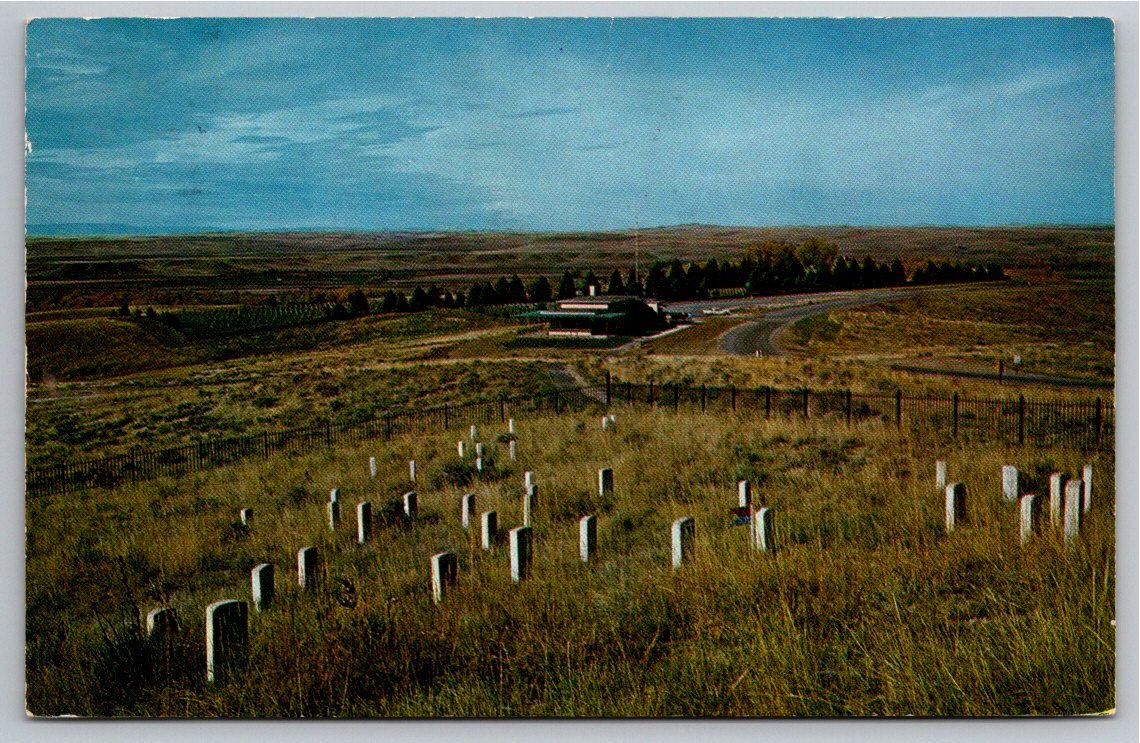
This vintage postcard captures a serene yet poignant vantage point across the sweeping expanse of southeastern Montana. Looking across the high-prairie slopes near Hardin, the image showcases the scattered white headstones of Custer Battlefield National Cemetery, set against the backdrop of rolling hills, winding roads, and the visitor complex below. Published in 1963 by Far West Studios of Virginia City, Montana, and postmarked in 1967, this piece serves as a remarkable mid-century snapshot of one of America's most deeply scrutinized historic landscapes.
The Evolution of a Sacred Landscape
The ground depicted in this card represents one of the pivotal turning points in American West history. On June 25–26, 1876, the Battle of the Little Bighorn unfolded across these wind-swept ridges, pitting the 7th Cavalry under Lieutenant Colonel George Armstrong Custer against a coalition of Lakota, Northern Cheyenne, and Arapaho warriors. Following the battle, the area quickly became a focus of national remembrance. In 1879, the site was officially designated a U.S. National Cemetery to preserve the original graves of military personnel and early frontier scouts.
For much of the twentieth century, the site was officially known as Custer Battlefield National Monument, a name formally established by Congress in 1946. It was not until 1991 that federal legislation signed by President George H.W. Bush renamed the site Little Bighorn Battlefield National Monument to reflect a more inclusive historical narrative honoring both Native American defenders and U.S. soldiers. Mid-century postcards like this one preserve the era when the location was primarily interpreted through its mid-20th-century National Park Service infrastructure and classic military cemetery layout.
Mid-Century Roadside Western Americana
Produced during the golden age of American road trips, this color chrome postcard reflects the booming era of post-war heritage tourism. Printed with deep blues and natural sun-baked tans, the photograph taken by McCollom for Far West Studios emphasizes the solitary grandeur of Big Sky Country. Tourists traveling through the Treasure State in the 1960s frequented these windswept ridges, purchasing cards at regional trading posts to document their journeys across the vast American West.
The reverse side features a cancellation mark from October 1967 alongside a classic four-cent Abraham Lincoln postage stamp. Hand-written personal notes detailing motorcycle trips across hundreds of miles of Western highways offer a personal window into mid-60s traveler culture, adding rich provenance to this physical artifact.
Preservation and Collector Context
For collectors of Western Americana, military history, and retro postcard ephemera, this piece stands out for its crisp focal balance and rich historic context. It bridges mid-century American travel culture with the enduring, complex memory of the Little Bighorn, making it a valued addition to any specialized archive of Montana geography or National Park Service history.