1928 Courthouse Rock Bridgeport Nebraska Vintage RPPC Postcard
📸 Click any thumbnail to inspect Front, Back & Angles (2 Photos)
As an eBay Partner, we may earn a commission if you make a purchase.
Item Specifications
- Era: 1920s
- Location: Bridgeport, Nebraska
- Subject: Courthouse Rock Landmark
- Postmark Date: August 1928
- Postage Stamp: 1-Cent Green Washington
- Originality: Original Vintage
- Category: Postcards & Ephemera
- Format / Type: Real Photo Postcards (RPPC)
Looking for Modern Alternatives?
Explore top-rated, modern Postcards & Ephemera and related historical accessories on Amazon.
Shop Postcards & Ephemera on Amazon →As an Amazon Associate, we earn from qualifying purchases.
Historical Context & Overview
A Window into Western History: Courthouse Rock in 1928
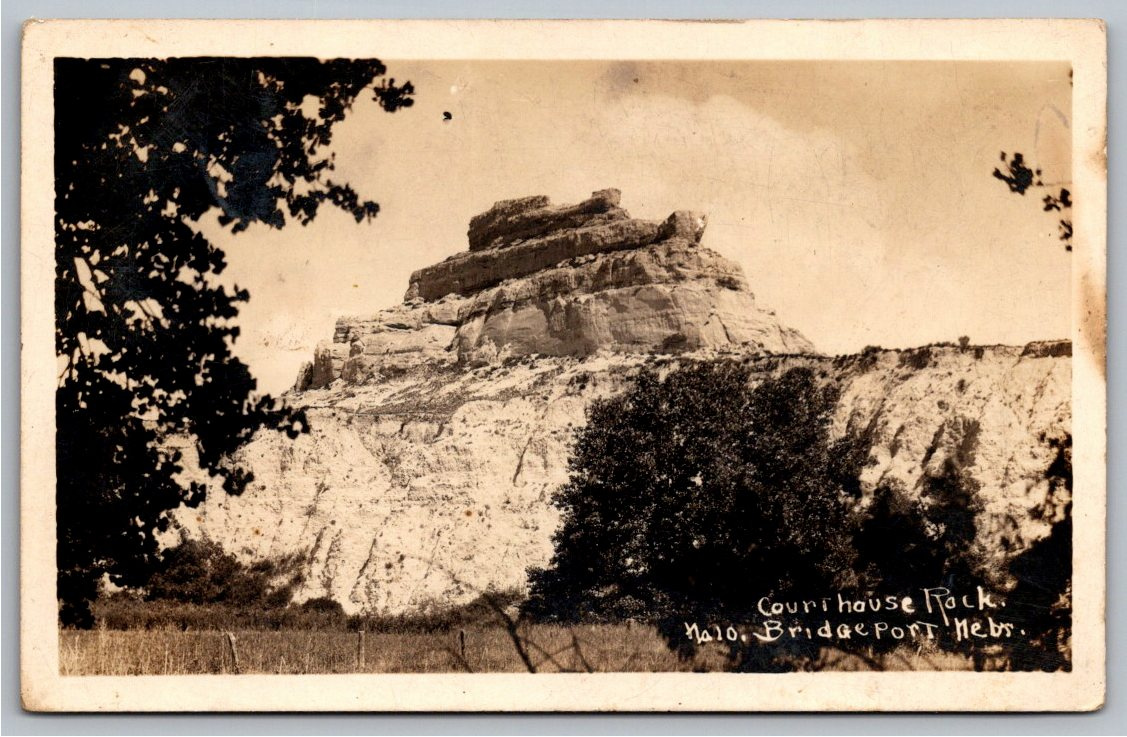
Rising dramatically above the North Platte River Valley near present-day Bridgeport, Nebraska, Courthouse Rock stands as one of the most celebrated and historically significant geological formations in the American West. Captured here in an authentic 1928 Real Photo Postcard (RPPC), this striking black-and-white image offers both a rich photographic study of natural grandeur and a fascinating tangible slice of early twentieth-century American travel history.
The Geological Sentinel of the Emigrant Trails
Composed of layers of clay, Arikaree sandstone, and volcanic ash, Courthouse Rock—along with its nearby companion, Jail Rock—served as a crucial navigational landmark for hundreds of thousands of nineteenth-century pioneers journeying westward. Travelers trekking along the Oregon, California, and Mormon Trails scanned the flat prairie horizon for these towering bluffs. Spotting Courthouse Rock provided crucial reassurance to emigrant trains that they were maintaining the proper route through the Panhandle of Nebraska toward the Rocky Mountains.
By the time this postcard was photographed and mailed in the late 1920s, the age of the covered wagon had given way to the modern era of cross-country automobile touring. The opening of improved state highways allowed early motorists to trace the historic routes of pioneer trains, pulling off the dusty roads to admire the exact same majestic monuments that had inspired diary entries decades earlier.
Real Photo Postcards: Capturing the Great American Road Trip
Unlike standard mass-produced lithographic postcards of the era, Real Photo Postcards were created by exposing continuous-tone photographic negatives directly onto postcard-backed developing paper. This photographic process yielded extraordinary fine details, rich silver gelatin shadows, and subtle highlights that lithography simply could not replicate. The white hand-lettered caption in the lower corner—reading "Courthouse Rock. No 10. Bridgeport Nebr."—reflects the work of a regional itinerant photographer documenting local landmarks for the growing tourist trade passing through Morrill County.
A Personal Dispatch from the Summer of 1928
The reverse side of this card provides a fascinating epistolary record that enhances its historical charm. Postmarked directly in Bridgeport, Nebraska, in August 1928, the postcard bears a crisp one-cent green George Washington stamp. The handwritten pencil inscription from travelers "Mae & Chas" addressed to Fairbury, Nebraska, reads in part: "Expect to reach Casper this evening. Got pretty cold last night." This brief, intimate message captures the real-world experience of late 1920s motorists braving changing western weather conditions as they traveled onward toward Wyoming.
Preserving Western Americana and Postal Heritage
For dedicated collectors of Nebraska postal history, trail lore, and vintage photographica, this 1928 real photo postcard represents an exceptional cross-section of subjects. It seamlessly combines natural geological grandeur, pioneer trail heritage, and an authentic snippet of early American road trip culture into a single, well-preserved paper artifact.