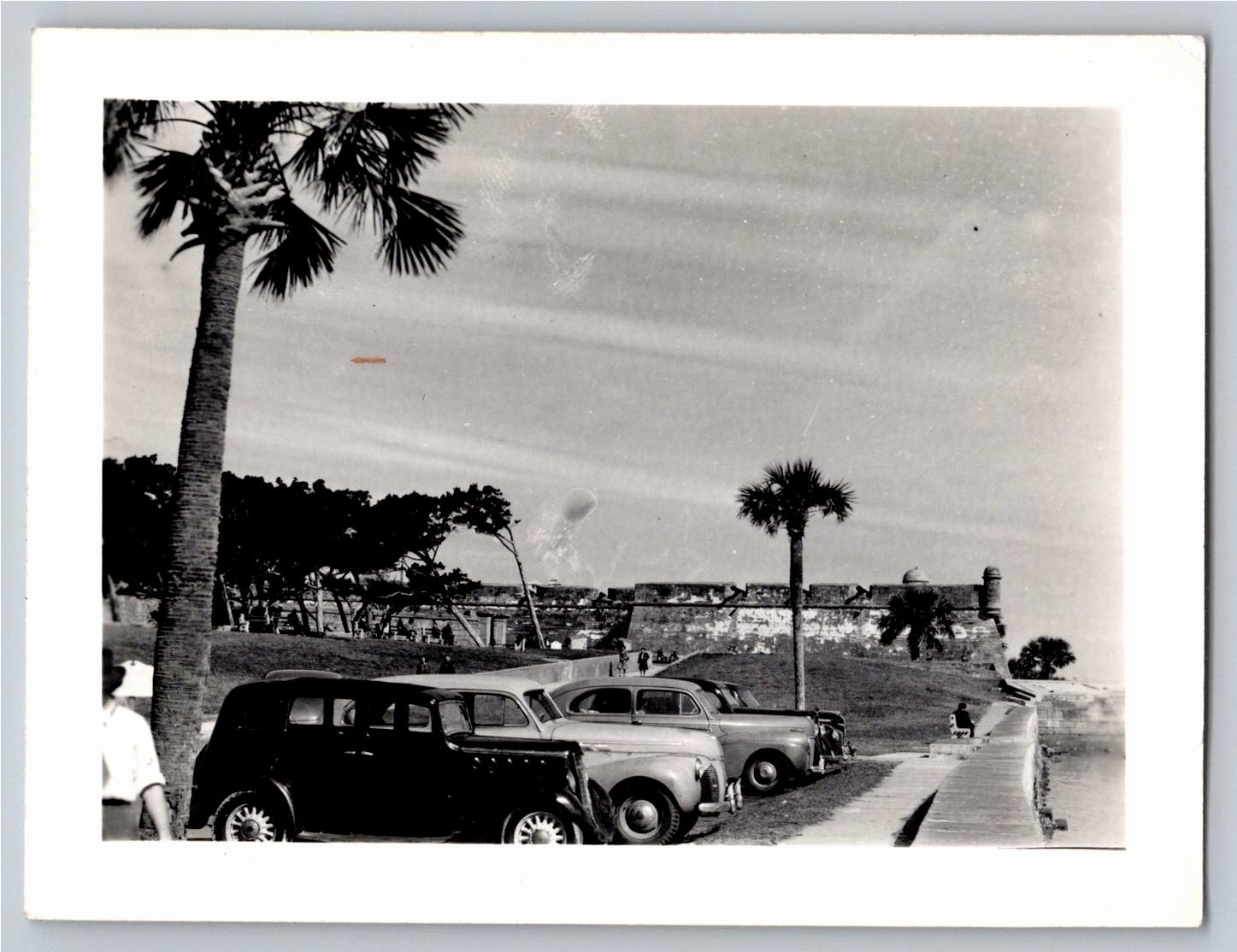
1940s Castillo de San Marcos St Augustine Florida Photo
📸 Click any thumbnail to inspect Front, Back & Angles (2 Photos)
🔗 Embed / Cite This Archival Image (Free with Attribution)Get HTML Code
© USA RESELL. Bloggers, historians, and website owners may embed this image for free by copying the HTML code below (which includes the required credit link back to this page):
USA RESELL is a living historical archive. Because original artifacts are one-of-a-kind and source records change rapidly, use the button above to check live marketplace availability or locate surviving examples. As an eBay Partner, we may earn a commission on qualifying purchases.
Item Specifications
- City: St. Augustine
- State: Florida
- Country: United States
- Era: 1940s
- Subject: Castillo de San Marcos Classic Cars Seawall
- Theme: Americana
- Category: Vintage Photography
- Format / Type: Snapshots
Historical Context & Overview
Mid-Century Motoring Along Matanzas Bay
This striking original silver gelatin print transports the viewer to the historic waterfront of St. Augustine, Florida, during the mid-1940s. Parked in a neat row adjacent to the concrete seawall are classic late 1930s and 1940s American passenger cars, showing off the curvaceous fenders, chrome bumpers, and distinctive styling of the pre- and post-World War II automotive era. Overhead, mature cabbage palmettos rise into a sweeping Florida sky, casting long shadows across the grass and providing quintessential sub-tropical ambiance to this relaxed scene of leisure.
In the background across the manicured green lawn stands the formidable profile of the Castillo de San Marcos. The weathered masonry of the historic Spanish colonial fortress stretches along the shoreline, punctuated by its iconic cylindrical stone sentry boxes, known as garitas. Strollers can be seen wandering the elevated grounds, while a lone individual sits contemplatively along the seawall coping, encapsulating the quiet charm of seaside tourism during the golden age of American road-trip travel.
Castillo de San Marcos and the Rise of Florida Tourism
Constructed between 1672 and 1695 by Spanish military engineers, the Castillo de San Marcos is the oldest masonry fortification in the continental United States. Built primarily from coquina—a locally quarried sedimentary rock composed of ancient shell fragments—the fort famously absorbed cannon fire rather than shattering, making it an impregnable stronghold through centuries of colonial conflict between Spain, Great Britain, and later the nascent United States. By 1924, having outlived its military purpose, the fortress was designated a National Monument.
Following the conclusion of World War II, Florida experienced an unprecedented boom in automotive tourism. Families journeyed south along coastal highways like U.S. Route 1, drawn by warm coastal breezes, Spanish colonial romance, and monumental heritage sites like the Castillo. This vernacular snapshot preserves that exact transitional era in American cultural history, where centuries-old stone fortifications met modern vehicular recreation and coastal hospitality.
Physical Characteristics, Technique, and Archival Preservation
Developed using traditional gelatin-silver chemistry on heavy, glossy photographic paper stock, this snapshot measures approximately 4.5 by 3.4 inches. The print retains wide, crisp white borders characteristic of professional photo-lab processing from the 1940s. Tonal contrast remains remarkable, featuring deep, rich blacks in the car bodies and foliage alongside luminous white highlights on the clouds and whitewashed stonework, free from excessive fading or chemical deterioration.
The reverse of the photograph is unprinted photographic paper, exhibiting a simple, vintage graphite inscription of the numeral "6" near the center, typical of mid-century sorting or album sequencing. The edges and corners are well preserved with minimal handling wear, making it an exemplary specimen of mid-20th-century vernacular Americana. It serves as an evocative piece for collectors of historic Florida memorabilia, classic automotive photography, and Spanish colonial architecture.