1950s Mid Century Living Room Family Barkcloth Sofa TV Photo
📸 Click any thumbnail to inspect Front, Back & Angles (2 Photos)
🔗 Embed / Cite This Archival Image (Free with Attribution)Get HTML Code
© USA RESELL. Bloggers, historians, and website owners may embed this image for free by copying the HTML code below (which includes the required credit link back to this page):
USA RESELL is a living historical archive. Because original artifacts are one-of-a-kind and source records change rapidly, use the button above to check live marketplace availability or locate surviving examples. As an eBay Partner, we may earn a commission on qualifying purchases.
Item Specifications
- City: Unspecified
- Country: United States
- Era: 1950s
- Subject: Family Mid Century Modern Furniture Television
- Theme: Americana Domestic and Family Life
- Year of Production: 1955
- Category: Vintage Photography
- Format / Type: Vintage Photographs
Historical Context & Overview
Mid-Century Domesticity and Post-War Living Room Aesthetics
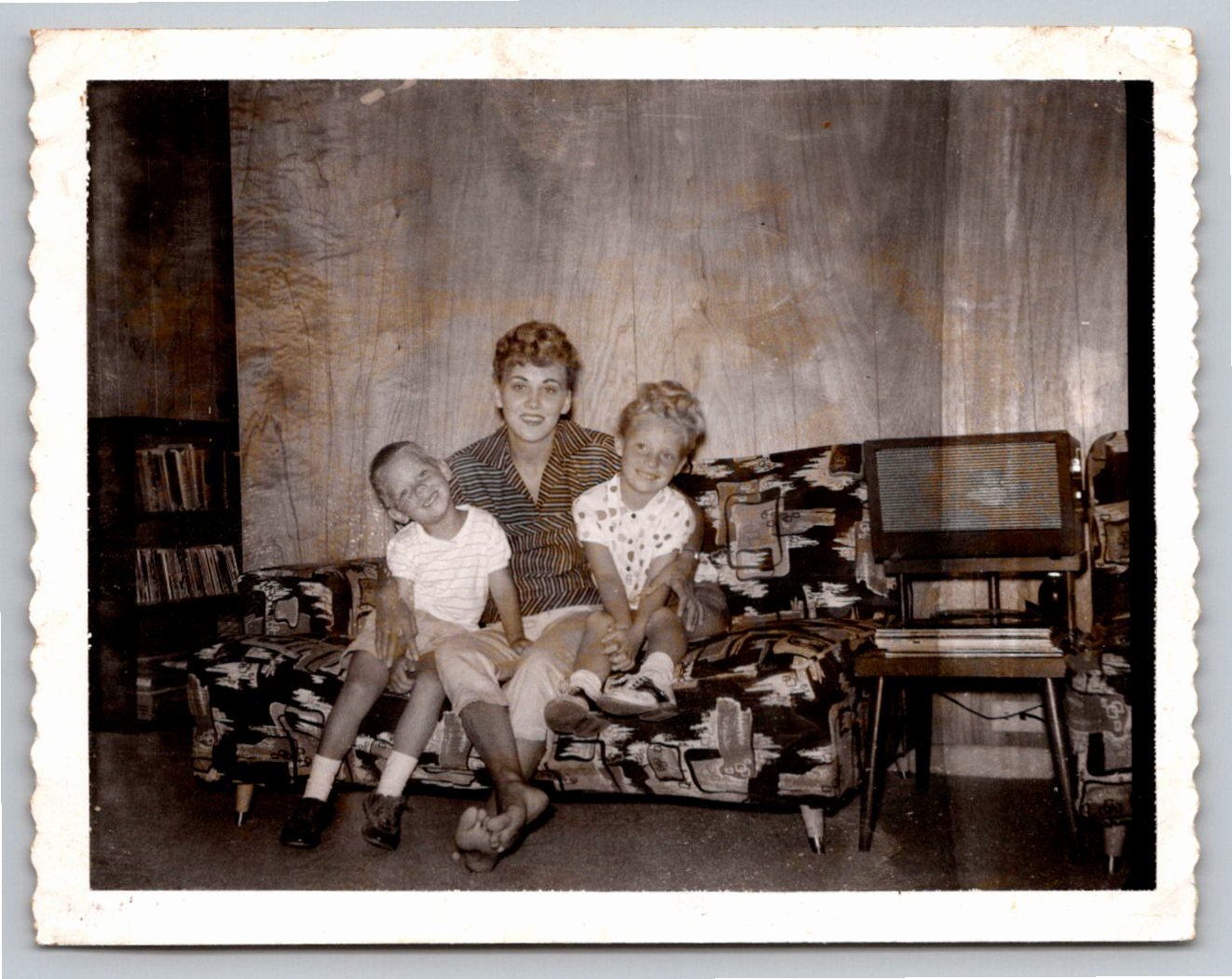
This authentic 1950s gelatin-silver snapshot provides an evocative window into mid-century American domestic culture. The image centers on an intimate family moment captured in the warmth of a suburban den or living room, featuring a smiling mother flanked by her young son and daughter. Dressed in quintessentially retro attire—the mother in a striped collared blouse and capri trousers, the son in a horizontal striped crew neck, and the daughter in a polka-dot short-sleeve top—the trio projects the relaxed, informal happiness characteristic of post-World War II family life. The candid charm is enhanced by the mother sitting playfully barefoot alongside her neatly shoed children.
Surrounding the family is a textbook display of mid-century modern interior design elements. They rest upon a low-slung sofa upholstered in striking atomic barkcloth fabric, patterned with abstract geometric and amoebic forms atop tapered peg legs. Positioned directly to their left is a compact tabletop television set perched upon an angled mid-century stand with tapered splayed legs, reflecting the booming arrival of television as the central focal point of American family entertainment. Along the paneled wall, a wire or wood rack holds reading materials or vinyl records, completing an iconic setting that represents the quintessential 1955 home environment.
The Cultural Rise of the Rumpus Room and Modern Furnishings
During the mid-1950s, residential home architecture underwent a profound transformation with the widespread adoption of the dedicated family room, finished basement, or rumpus room. Backed by distinctive wood wall paneling, this setting showcases how new construction materials and casual spaces supplanted the formal parlors of previous generations. Furnishings in these spaces shifted from heavy, ornate hardwoods to streamlined, functional pieces championed by modern industrial designers, making high-style aesthetics accessible to everyday middle-class households.
Barkcloth textiles became the defining decorative fabric of the era, known for their distinctive heavy-weave texture and bold, futuristic patterns inspired by modern art, scientific discovery, and the Space Age. Paired with the rapidly expanding availability of black-and-white television broadcasts, rooms like the one documented here served as the epicenter of leisure and shared familial experience. The natural composition of this photograph captures this cultural watershed not as an idealized magazine advertisement, but as an authentic lived reality.
Format, Preservation, and Archival Collector Significance
Measuring approximately 4.1 by 3.2 inches, this original vintage print is executed on classic silver gelatin photographic paper featuring decorative scalloped deckle edges. These serrated borders were a hallmark finishing option favored by commercial photo-finishing laboratories throughout the 1940s and 1950s. The reverse remains uninscribed, retaining only a faint period lab processing sequence stamp bearing the numeral "42" along the top margin and a subtle edge indicator, confirming its origin as an authentic amateur camera exposure developed during the mid-twentieth century.
In terms of physical preservation, the photograph survives in attractive vintage condition. The paper displays gentle age toning, subtle silvering along darker emulsion areas, and faint surface handling appropriate for an original mid-century print, while the delicate die-cut deckle borders remain crisp without deep folds, creases, or tears. For historians of Americana, collectors of vernacular photography, and enthusiasts of atomic-era interior decor, this print stands as an exceptional visual record of 1950s family life and design.