1950s Boys on Harbor Dock with Wooden Boats Vintage Photo
📸 Click any thumbnail to inspect Front, Back & Angles (2 Photos)
🔗 Embed / Cite This Archival Image (Free with Attribution)Get HTML Code
© USA RESELL. Bloggers, historians, and website owners may embed this image for free by copying the HTML code below (which includes the required credit link back to this page):
USA RESELL is a living historical archive. Because original artifacts are one-of-a-kind and source records change rapidly, use the button above to check live marketplace availability or locate surviving examples. As an eBay Partner, we may earn a commission on qualifying purchases.
Item Specifications
- Type: Photograph
- Theme: Maritime
- Subject: Boys at Harbor Dock
- Era: Mid-Century
- Year of Production: 1955
- Time Period Manufactured: 1950-1959
- Category: Vintage Photography
- Format / Type: Snapshots
Historical Context & Overview
Mid-Century Waterfront Scene: Youth Along the Bulkhead
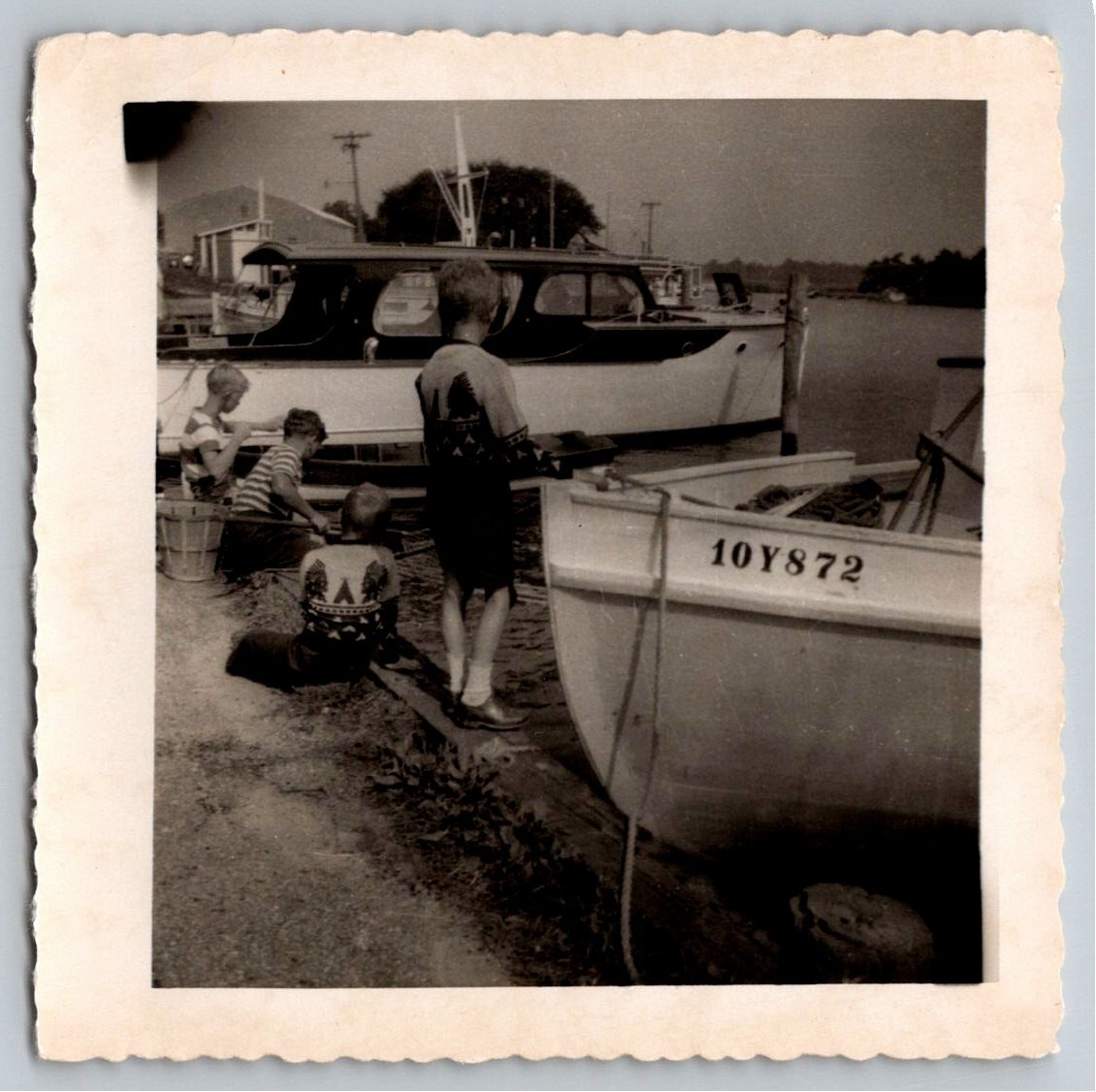
This evocative mid-1950s black-and-white snapshot presents an unvarnished glimpse into mid-century American recreational life along a sheltered coastal waterway. The composition centers on a group of four young boys lingering on a wooden pier bulkhead, their attention drawn downward toward the gentle currents of the harbor. Dressed in the casual, enduring fashion of the post-war era—patterned knit shirts, cuffed trousers, and neat leather shoes—the youths embody the quiet, self-directed freedom that characterized mid-century childhood. A woven utility basket rests nearby on the sun-bleached planks, hinting at crabbing, fishing, or a morning spent collecting harbor treasures.
Beside the boys, the visual narrative is grounded by period maritime craftsmanship. In the foreground rests a classic wooden utility skiff bearing the crisp registration number 10 Y 872 painted across its bow flare. Moored further along the channel stands an elegant vintage wooden cabin cruiser, complete with a dark-trimmed deckhouse, varnished coaming, and a tall radio or signal mast silhouetted against the sky. The interplay between the weathered timber of the shoreline and the glossy surfaces of the vessels provides rich nautical atmosphere, capturing a vanished era when recreational boating was defined by mahogany and oak rather than fiberglass.
Everyday Coastal Americana and Vernacular Photography
During the post-World War II economic expansion, family leisure time flourished, spurring a widespread surge in domestic coastal travel and dockside hobbies. Small community harbors and working marinas formed social hubs where commercial fishing vessels coexisted naturally with family motor launches and rowboats. This candid photograph captures that seamless coexistence, immortalizing an ordinary summer afternoon without the rigid staging common to professional promotional prints. The unposed postures of the children—some leaning thoughtfully over the water, others crouching to inspect lines or tackle—reflect the unhurried tempo of coastal life in the 1950s.
As a piece of vernacular photojournalism, the image highlights the democratic nature of mid-century amateur cameras, such as popular Kodak Brownie or Ansco models. These portable roll-film cameras empowered families to chronicle unscripted memories in high fidelity. The natural daylight casts clean, balanced illumination across the channel, preserving fine surface details ranging from the subtle wood grain on the skiff's hull to the telephone utility poles and harbor warehouse rooflines in the distant background.
Print Characteristics, Preservation, and Archival Value
The physical artifact is an original square-format gelatin-silver snapshot measuring approximately 3.5 by 3.5 inches, struck directly onto traditional fiber-base photographic paper. The print features the distinctive deckled, scalloped borders produced by specialized commercial photofinishing shears widely utilized between the late 1940s and mid-1950s. Its tonal range remains remarkably healthy, exhibiting rich charcoal blacks, bright white highlights, and a full spectrum of silvery midtones that preserve depth across the boat hulls and rippling water.
The reverse side of the print is completely blank, free of photograph dividing lines, publisher credits, commercial backstamps, or handwritten inscriptions, solidifying its provenance as a private family photograph rather than a mass-market souvenir. Well protected over the decades, the photograph displays negligible surface wear, sharp paper corners, and minimal border handling. For collectors of mid-century Americana, nautical history, and authentic maritime photography, this snapshot offers an authentic and beautifully preserved window into 1950s dockside leisure.