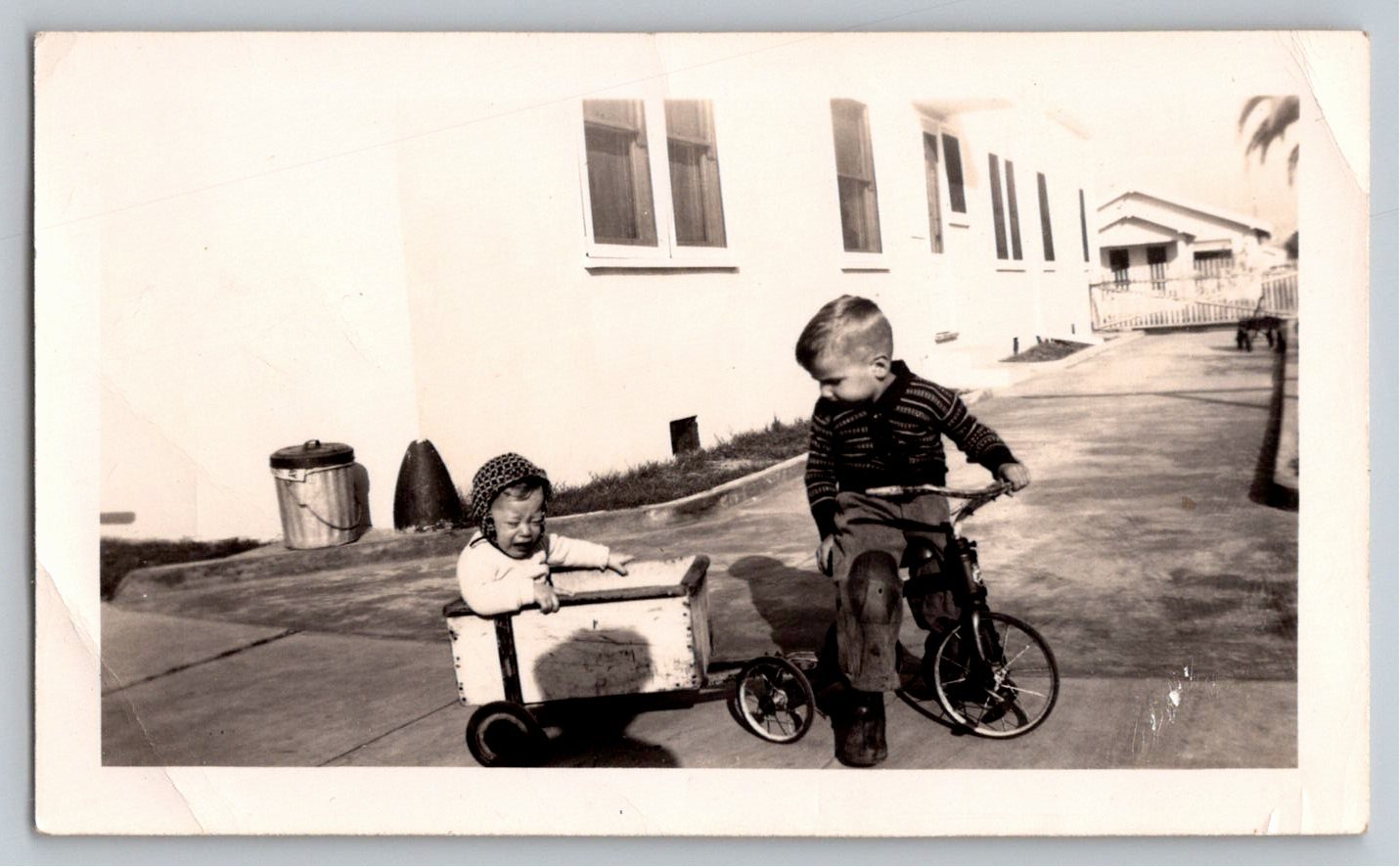
1950s Snapshot Boy on Tricycle Pulling Baby in Wagon
📸 Click any thumbnail to inspect Front, Back & Angles (2 Photos)
🔗 Embed / Cite This Archival Image (Free with Attribution)Get HTML Code
© USA RESELL. Bloggers, historians, and website owners may embed this image for free by copying the HTML code below (which includes the required credit link back to this page):
USA RESELL is a living historical archive. Because original artifacts are one-of-a-kind and source records change rapidly, use the button above to check live marketplace availability or locate surviving examples. As an eBay Partner, we may earn a commission on qualifying purchases.
Item Specifications
- City: Unspecified
- Country: United States
- Era: 1950s
- Subject: Children Tricycle Wagon Siblings
- Theme: Americana Domestic and Family Life
- Year of Production: 1950
- Category: Vintage Photography
- Format / Type: Snapshots
Historical Context & Overview
Mid-Century Siblinghood in Postwar Suburbia
This candid mid-20th-century vernacular snapshot preserves a humorous and thoroughly relatable vignette of American domestic life. Centered on an expansive residential driveway, an older brother pauses astride his classic metal tricycle, turning back with an expression of mild bewilderment or amusement toward his younger sibling. Towed behind the three-wheeler rests a sturdy, hand-built wooden wagon serving as an impromptu carriage. Nestled securely inside is an infant dressed in a heavy knitted sweater and a snug, textured bonnet, mouth open in an unmistakable mid-ride wail that cuts through the sunlit suburban afternoon.
The visual setting reinforces the optimism and spatial expansion of the postwar housing boom. Bathed in brilliant daylight, the smooth concrete driveway borders a crisp stucco home featuring multi-pane double-hung windows, a low foundation vent, and clean exterior lines indicative of architectural trends in California and the Sunbelt states during the 1950s. In the perimeter background, glimpses of a galvanized metal trash can, modest yard fencing, and tropical palm foliage anchor the photograph firmly within an authentic neighborhood setting of the era.
Vernacular Photography, Playtime, and Material Culture
Beyond its charm as a candid domestic moment, the image stands as a documentary record of 1950s childhood material culture. The boy’s velocipede-style tricycle—with its spoke-rim front wheel, tubular frame, and broad handlebars—reflects the durable, heavy-gauge steel construction standard in American toy manufacturing before the widespread shift toward injection-molded plastics. Meanwhile, the utilitarian wooden pull-cart illustrates the prevalent do-it-yourself spirit of postwar fathers, who frequently repurposed timber, hardware, and small rubber wheels into custom wagons for neighborhood yard play.
The unposed spontaneity of the photograph showcases the creative power of vernacular photography during the golden age of consumer roll film. Armed with medium format folding cameras or convenient box viewfinders, family chroniclers documented the unscripted realities of domestic life rather than relying solely on rigid, formal studio portraits. The crying baby’s distress juxtaposed against the older brother’s proud mechanical transport represents an unguarded moment of genuine sibling interaction that resonated across generations of mid-century family albums.
Physical Attributes, Processing, and Archival Condition
Rendered via traditional gelatin-silver chemistry on glossy paper stock, the photograph measures approximately 4.5 inches by 2.7 inches. The print displays strong tonal range, characterized by luminous bright whites along the sun-struck stucco walls and deep, velvety blacks within the tire treads, knitwear patterns, and asphalt shadows. The reverse side is clean and uncaptioned, showing only an original green three-digit photofinishing control stamp reading "057," typical of commercial neighborhood film processing labs of the 1950s.
Overall, this original snapshot remains in very good vintage condition, exhibiting gentle handling wear commensurate with its age. Subtle corner creasing is present at the upper-right and lower-left margins, accompanied by mild perimeter softening that does not infringe upon the primary subjects. With its sharp focal clarity, excellent contrast, and endearing narrative appeal, this print represents an exemplary collector's piece of mid-century Americana and vernacular photojournalism.