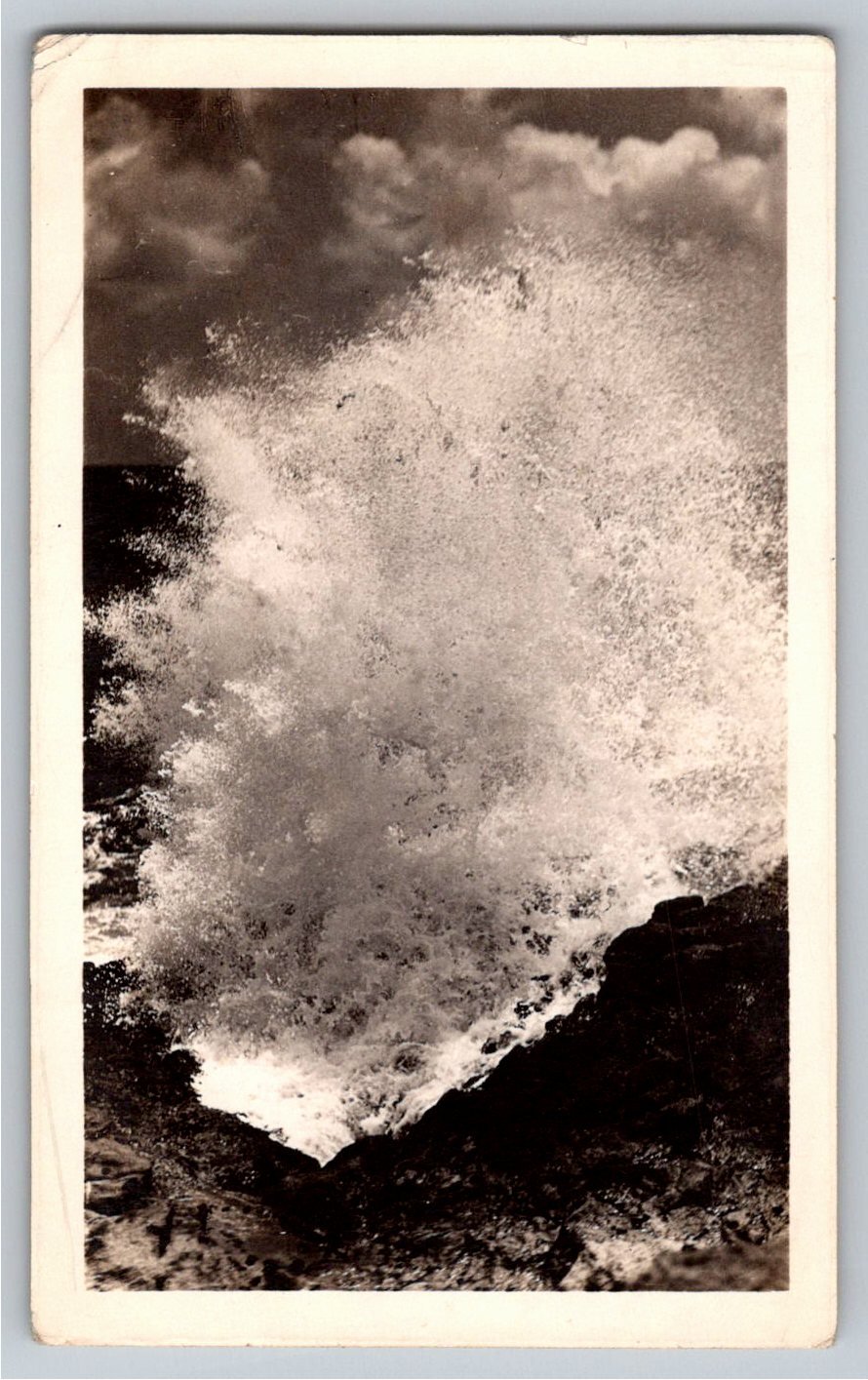
1930s Halona Blowhole Honolulu Hawaii Vintage Photograph
📸 Click any thumbnail to inspect Front, Back & Angles (2 Photos)
🔗 Embed / Cite This Archival Image (Free with Attribution)Get HTML Code
© USA RESELL. Bloggers, historians, and website owners may embed this image for free by copying the HTML code below (which includes the required credit link back to this page):
USA RESELL is a living historical archive. Because original artifacts are one-of-a-kind and source records change rapidly, use the button above to check live marketplace availability or locate surviving examples. As an eBay Partner, we may earn a commission on qualifying purchases.
Item Specifications
- City: Honolulu
- State: Hawaii
- Country: United States
- Era: 1930s-1940s
- Subject: Ocean Waves Halona Blowhole
- Theme: Hawaiiana
- Category: Vintage Photography
- Format / Type: Snapshots
Historical Context & Overview
Visual & Historical Overview: The Fury of Oahu’s Volcanic Shoreline
This striking original silver gelatin print captures an awe-inspiring moment of natural power along the southeastern shoreline of Oahu, Hawaii. Prominently framed within the composition is the dramatic eruption of sea spray geysering skyward from the famous geological formation known colloquially as The Blow Hole, or Halona Blowhole. Caught precisely at the apex of its upward surge, the frothing white spray creates an intense tonal contrast against the deep black basaltic volcanic rocks anchored in the foreground. Atmospheric cloud formations roll across the upper expanse, providing a moody, cinematic backdrop that emphasizes the raw, untamed elements of the Pacific Ocean during the pre-war era.
Dating to the 1930s to 1940s, this photograph represents the burgeoning era of maritime leisure and Pacific tourism, when adventurous voyagers traveled by steamship to explore the Hawaiian Islands. While commercial photographs often depicted serene, palm-fringed lagoons of Waikiki, this personal snapshot focuses instead on the elemental ferocity of the coast. The photographer timed the exposure with great precision, freezing thousands of individual droplets of atomized surf as ocean swells surged into the submerged lava tube below and vented explosively into the open air.
Geological Significance and Period Back-Stamp Authentication
Formed thousands of years ago during the rejuvenation stage of the Koolau volcanic range, the Halona Blowhole was created when molten basalt lava flows solidified on their outer crust while molten rock continued to drain from within, leaving behind hollow subterranean lava tubes. When relentless trade-wind swells force ocean water into these submerged passages, the narrowing chamber compresses the incoming water until it breaches the surface through an opening in the rocky ledge. This geological marvel has long fascinated locals and travelers alike, serving as a primary roadside attraction along Kalanianaole Highway as Oahu expanded its scenic coastal transit corridors in the early twentieth century.
On the reverse of this print is a crisp, vintage purple-black hand-stamp identifying the subject matter: "THE BLOW HOLE near Honolulu, Hawaii Hawaiian Islands." This mid-century identification stamp, paired with the faint vintage paper watermark visible in the photographic fiber substrate, firmly authenticates the piece as a genuine tourist or traveler snapshot rather than a mass-produced photograph or modern offset lithograph. Stamped text of this variety was frequently applied by local processing labs or commercial camera shops in Honolulu to assist travelers in cataloging their island keepsakes upon developing their film.
Print Characteristics, Condition, and Archival Provenance
Printed on classic semi-gloss silver gelatin paper stock, the photograph measures approximately 2.7 inches by 4.4 inches, a customary aspect ratio for vest-pocket snapshot cameras of the interwar period. The classic white borders neatly frame the high-contrast tonal spectrum, which ranges from velvety charcoal shadows within the volcanic basalt to brilliant, unblown whites in the cresting sea mist. The tonal fidelity is remarkably well-preserved, retaining sharp granular texture throughout the midtones of the stormy sky and oceanic spray.
In terms of condition, this historic Hawaiian photographic artifact survives in very good vintage state. It exhibits gentle corner softening, a faint handling crease confined to the upper-left margin well outside the primary image area, and subtle, natural age toning across the blank verso that confirms its historic age and handling. Free from destructive tape residues, mounting abrasions, or tears, it serves as an evocative piece of early Hawaiiana ephemera, perfectly suited for collectors of Pacific travel archives, vintage maritime imagery, and regional American geology.