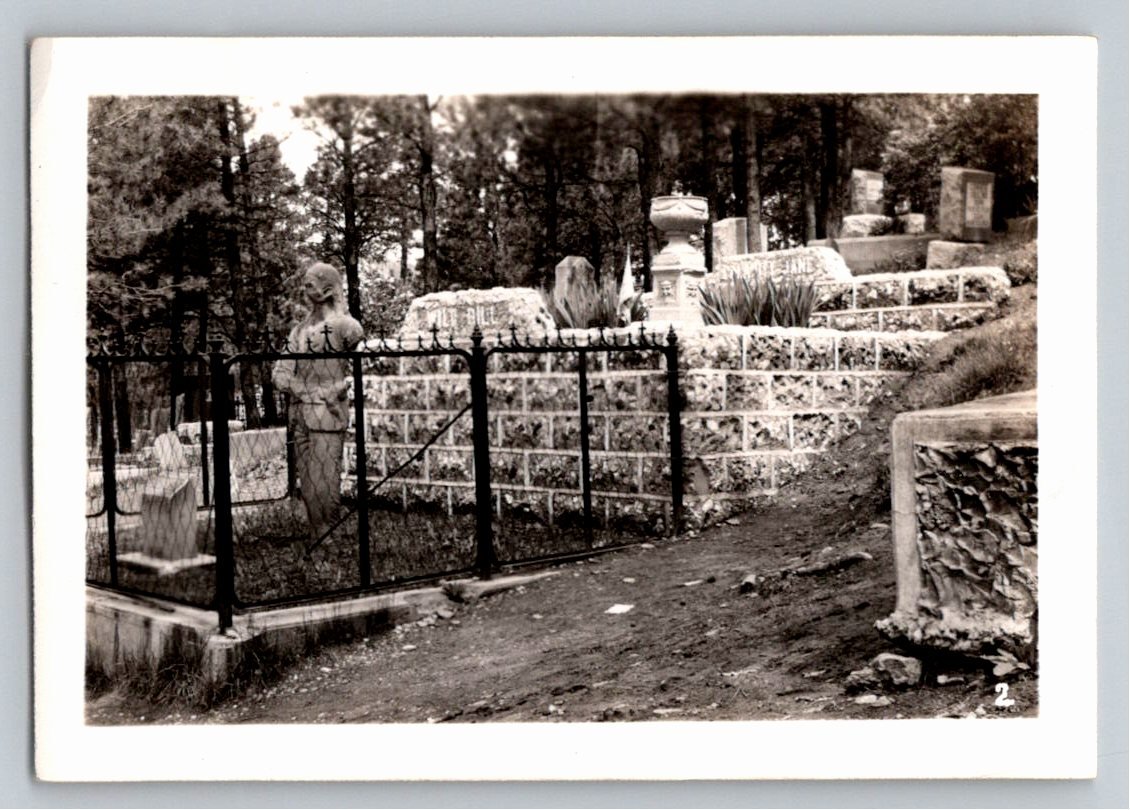
Wild Bill Hickok Calamity Jane Grave Mount Moriah 1940s Photo
📸 Click any thumbnail to inspect Front, Back & Angles (2 Photos)
🔗 Embed / Cite This Archival Image (Free with Attribution)Get HTML Code
© USA RESELL. Bloggers, historians, and website owners may embed this image for free by copying the HTML code below (which includes the required credit link back to this page):
USA RESELL is a living historical archive. Because original artifacts are one-of-a-kind and source records change rapidly, use the button above to check live marketplace availability or locate surviving examples. As an eBay Partner, we may earn a commission on qualifying purchases.
Item Specifications
- Type: Photograph
- Subject: Wild Bill Hickok Calamity Jane Mount Moriah Cemetery
- Theme: Americana
- Era: Mid-20th Century
- Year of Production: Unspecified
- Time Period Manufactured: 1940-1949
- Category: Vintage Photography
- Format / Type: Snapshots
Historical Context & Overview
Wild Bill Hickok and Calamity Jane: Iconic Resting Places at Mount Moriah
Perched high above the historic gold rush town of Deadwood, South Dakota, Mount Moriah Cemetery serves as the legendary eternal resting ground for some of the American frontier's most notorious figures. This original mid-century vintage photograph captures the hillside burial enclave shared by James Butler "Wild Bill" Hickok and Martha Jane Cannary, universally celebrated in Western folklore as Calamity Jane. Set against the steep, pine-studded slopes of the Black Hills, the image offers a striking glimpse of the elaborate rusticated stone terraces, tiered masonry retaining walls, and surrounding woodland canopy that define this revered burial ground.
Prominently featured within the foreground composition is the protective, decorative cast-iron enclosure encompassing Wild Bill's plot. Behind the ironwork stands a carved stone bust memorializing the scout and lawman, while immediately adjacent on the ascending terrace rests the grave and headstone of Calamity Jane. A classical urn planter punctuates the stone architecture, adding formal cemetery ornamentation to the otherwise rugged mountain terrain. The lower right edge shows a worn earthen footpath, bearing witness to decades of travelers making the uphill pilgrimage to pay homage to these frontier icons.
Deadwood's Gold Rush Lore and Mid-Century Western Tourism
The historical significance of Mount Moriah was forever established in August 1876 when Hickok was assassinated from behind during a poker game inside Deadwood's Nuttal & Mann's Saloon No. 10. Originally buried in the town's Ingelside Cemetery, Hickok's remains were reinterred at Mount Moriah in 1879 as the settlement expanded. Calamity Jane's connection to Wild Bill was cemented in public memory when, upon her death in 1903, her burial was arranged directly alongside him—honoring her purported final wish, though contemporary friends also noted the pairing was partly a mischievous final tribute by local townsfolk.
By the 1940s, the Black Hills had developed into a premier destination for American automobile tourism, spurred by the completion of nearby Mount Rushmore and the enduring romanticization of the Wild West. Traveling motorists frequently ventured up the winding roads of Deadwood to document Mount Moriah's frontier graves with personal roll-film cameras. This snapshot encapsulates that mid-20th-century road-trip era, preserving an authentic traveler's perspective of an iconic Americana heritage landmark before subsequent modern restorations and altered visitor pathways.
Physical Print Characteristics, Provenance, and Condition
Measuring approximately 3.5 by 2.4 inches, this original gelatin silver photograph represents a classic mid-century snapshot format. The visual presentation features clean, crisp white borders enclosing a finely detailed image with balanced tonal separation, rendering sharp contrasts between the weathered stones, iron railings, and dense evergreen foliage. In the lower right corner of the image area, a small white exposure number "2" appears, mirrored on the otherwise clean, blank verso by a stamped purple ink number "2"—a classic sign of vintage photo-finishing laboratory batch sequencing.
The print remains in very good vintage condition, exhibiting smooth semi-gloss surface preservation, sharp edges, and only minimal corner wear typical of carefully stored personal album prints from the 1940s. The reverse side shows no postal cancellation, adhesive residue, or paper loss, confirming its status as an untouched vintage photographic artifact. For collectors of Black Hills ephemera, Old West lawmen, and mid-century travel photography, this authentic snapshot represents a tangible piece of enduring American lore.