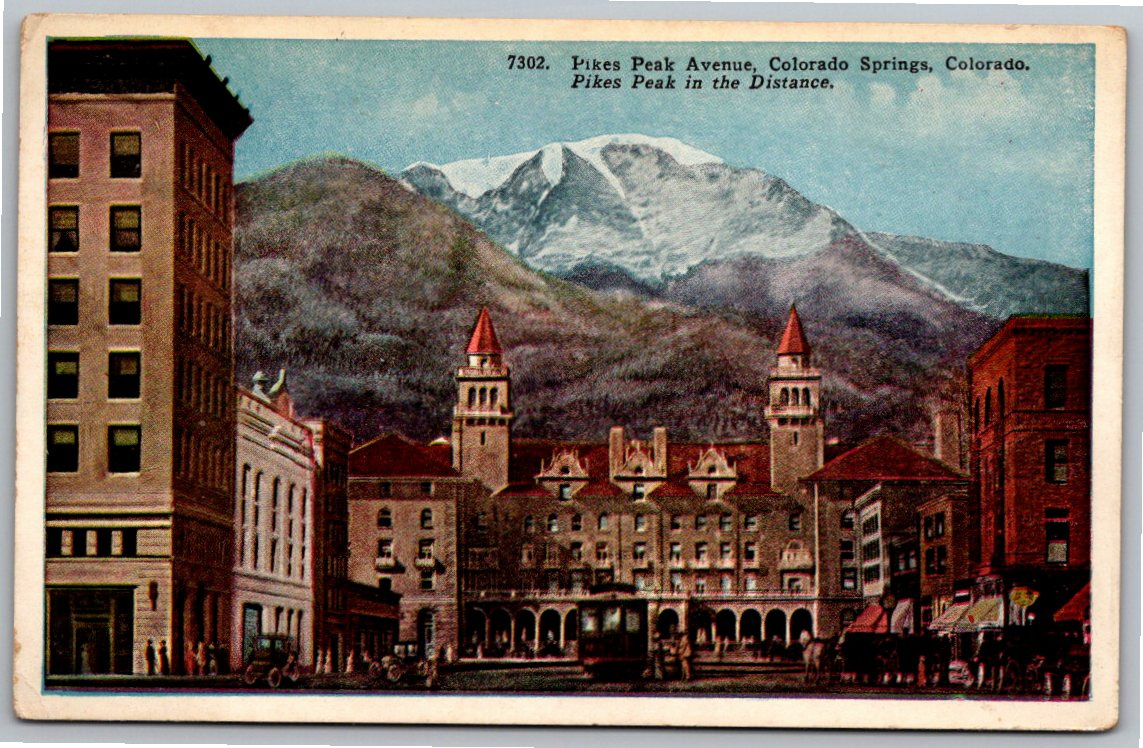
1910s Antlers Hotel & Pikes Peak Avenue Colorado Springs Postcard
📸 Click any thumbnail to inspect Front, Back & Angles (2 Photos)
As an eBay Partner, we may earn a commission if you make a purchase.
Item Specifications
- Era: 1910s Divided Back
- Location: Colorado Springs, Colorado
- Subject: Antlers Hotel & Pikes Peak
- Print Type: Color Lithograph
- Condition: Unused Vintage
- Originality: Original
- Category: Postcards & Ephemera
- Format / Type: Vintage Postcards
Looking for Modern Alternatives?
Explore top-rated, modern Postcards & Ephemera and related historical accessories on Amazon.
Shop Postcards & Ephemera on Amazon →As an Amazon Associate, we earn from qualifying purchases.
Historical Context & Overview
A Gateway to the Rockies: Pikes Peak Avenue and the Antlers Hotel
At the turn of the twentieth century, Colorado Springs stood as one of North America’s premier luxury health and leisure destinations. Founded in 1871 by Civil War veteran General William Jackson Palmer, the city was meticulously planned around wide avenues, mountain vistas, and grand architecture. Few vistas captured the imagination of travelers quite like the view gazing west down Pikes Peak Avenue toward the magnificent Antlers Hotel, framed dramatically against the soaring summit of Pikes Peak itself.
This early 1910s color lithograph postcard perfectly captures that iconic urban landscape during the height of the postcard collecting craze. Framed by emerging brick commercial buildings and bustling streetfronts, the Antlers Hotel serves as the architectural centerpiece of the avenue, its dual spires reaching upward to mirror the snow-draped peak rising over 14,000 feet in the background.
The Evolution of the Second Antlers Hotel
The structure depicted in this vintage postcard is the second iteration of the Antlers Hotel. The original wood-frame hotel, built in 1883, was tragically destroyed by a catastrophic fire in October 1898 when a nearby freight car carrying explosives caught fire. Undeterred, General Palmer commissioned Denver architects Varian and Sterner to design a far grander, fireproof successor.
Completed in 1901, the second Antlers Hotel featured striking Italian Renaissance Revival architecture constructed from buff-colored brick and stone. Its defining characteristics were the twin octagonal towers capped with red-tiled conical roofs, visible at the western terminus of Pikes Peak Avenue. The resort boasted state-of-the-art amenities, including fireproof construction, electric lights, private bath suites, and an extensive arcade. For over six decades, it welcomed U.S. presidents, international dignitaries, and affluent health-seekers drawn to the fresh mountain air of the Rockies.
Streetcars, Architecture, and Early 1900s Urban Life
Beyond its architectural spotlight on the Antlers, this postcard offers a vivid snapshot of early twentieth-century transit and streetscape culture in Colorado. Positioned prominently in the foreground center is an electric streetcar operating along the street railway lines established by the Colorado Springs and Interurban Railway. To the left and right, horse-drawn carriages share the broad thoroughfare with early automobiles, illustrating a pivotal era of technological transition in Western American transportation.
The publisher’s descriptive text printed on the divided back notes that Colorado Springs sits over 6,000 feet above sea level and highlights the city’s reputation as a world-renowned health resort. The postcard was manufactured during the "Divided Back Era" (1907–1915), a period during which the United States Postal Service first permitted messages to be written alongside the address on the back of the card, leaving the entire front image dedicated to full-color artwork.
Significance for Ephemera and Colorado Historians
For collectors of Western Americana, Colorado postal history, and historic architecture, this fine 1910s postcard remains an enduring artifact. Although the second Antlers Hotel was eventually demolished in 1964 to make way for a modern high-rise complex, color printed postcards such as this preserve the elegance and optimism of Colorado Springs during its golden age of grand hotel tourism.