Custer Battlefield MT F & I Company Positions Vintage Postcard
📸 Click any thumbnail to inspect Front, Back & Angles (2 Photos)
As an eBay Partner, we may earn a commission if you make a purchase.
Item Specifications
- Era: 1950s-1960s Chrome
- Publisher: Ellis Post Card Co.
- Photographer: Ken F. Roahen
- Location: Crow Agency, Montana
- Subject: Little Bighorn / Custer Battlefield
- Originality: Original Vintage
- Category: Postcards & Ephemera
- Format / Type: Vintage Postcards
Looking for Modern Alternatives?
Explore top-rated, modern Postcards & Ephemera and related historical accessories on Amazon.
Shop Postcards & Ephemera on Amazon →As an Amazon Associate, we earn from qualifying purchases.
Historical Context & Overview
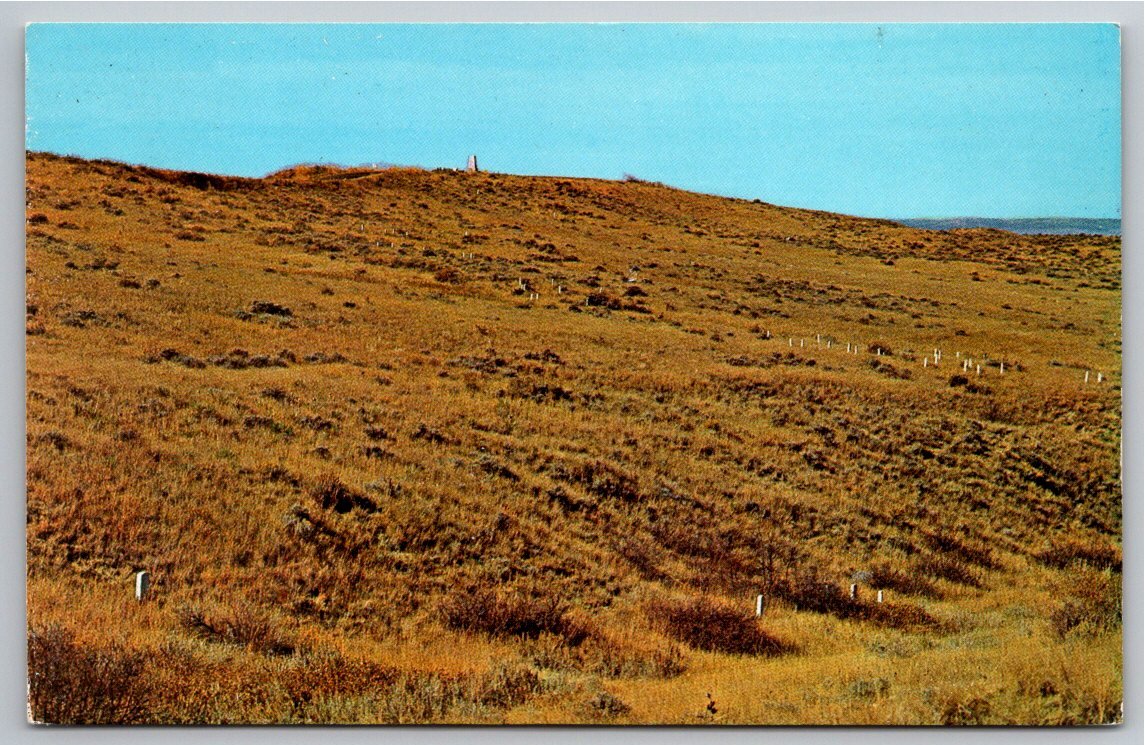
Perched upon the rugged, sun-bleached hillsides of southeastern Montana, the battlefield along the Little Bighorn River remains one of the most poignant landscapes in American military history. This vintage chrome-era postcard offers an evocative vantage point across the sweeping terrain of the former Custer Battlefield National Monument, capturing the defensive positions occupied by Companies F and I of the U.S. 7th Cavalry during the fateful afternoon of June 25, 1876. Against the expansive blue sky, white marble markers dot the amber grasses, highlighting where fallen troopers were buried where they stood, while the distant granite monument sits atop Last Stand Hill on the horizon.
The Fateful Positions of Companies F and I
In the tactical disintegration of Lieutenant Colonel George Armstrong Custer’s five-company battalion, Company I, under the command of Irish-born Captain Myles Keogh, was deployed along a prominent ridge to hold off advancing Lakota, Northern Cheyenne, and Arapaho warriors. Company F, commanded by Captain George Yates, operated nearby in support of the northern sector. Keogh’s men faced overwhelming odds as warriors led by prominent leaders such as Crazy Horse and Gall swept around their flanks. The concentration of grave markers seen in the right background indicates where Keogh and his command made their desperate stand. Remarkably, Keogh’s mount, a gelding named Comanche, survived severe wounds suffered during the battle and went on to become an enduring symbol of the 7th Cavalry, honored as the sole living mount discovered on the field by responding relief forces.
Mid-Century Photography and Historical Nomenclature
Captured by notable Montana photographer and wildlife federal agent Ken F. Roahen using Kodak’s iconic Ektachrome color film, this image displays the vivid, warm color palette characteristic of mid-century American postcards. Published by the Ellis Post Card Company of Arlington, Washington, the card bears the catalog number C-2015 and reflects the classic aesthetic of 1950s and 1960s travel ephemera. Furthermore, the caption explicitly references the site as "Custer Battlefield National Monument"—the official federal name established in 1946. In 1991, legislation was enacted renaming the park to Little Bighorn Battlefield National Monument to better honor all who fought in the historic engagement, making printed items bearing the original designation key pieces of mid-century National Park Service history.
An Authentic Artifact for Western Americana Enthusiasts
For collectors of Western Americana, military history ephemera, and vintage National Park postcards, this unposted card serves as both a photographic time capsule and a solemn visual document. Its clean back, crisp print details, and sharp landscape perspective make it an exceptional addition to any curated collection dedicated to the Battle of the Little Bighorn or historic Montana geography.