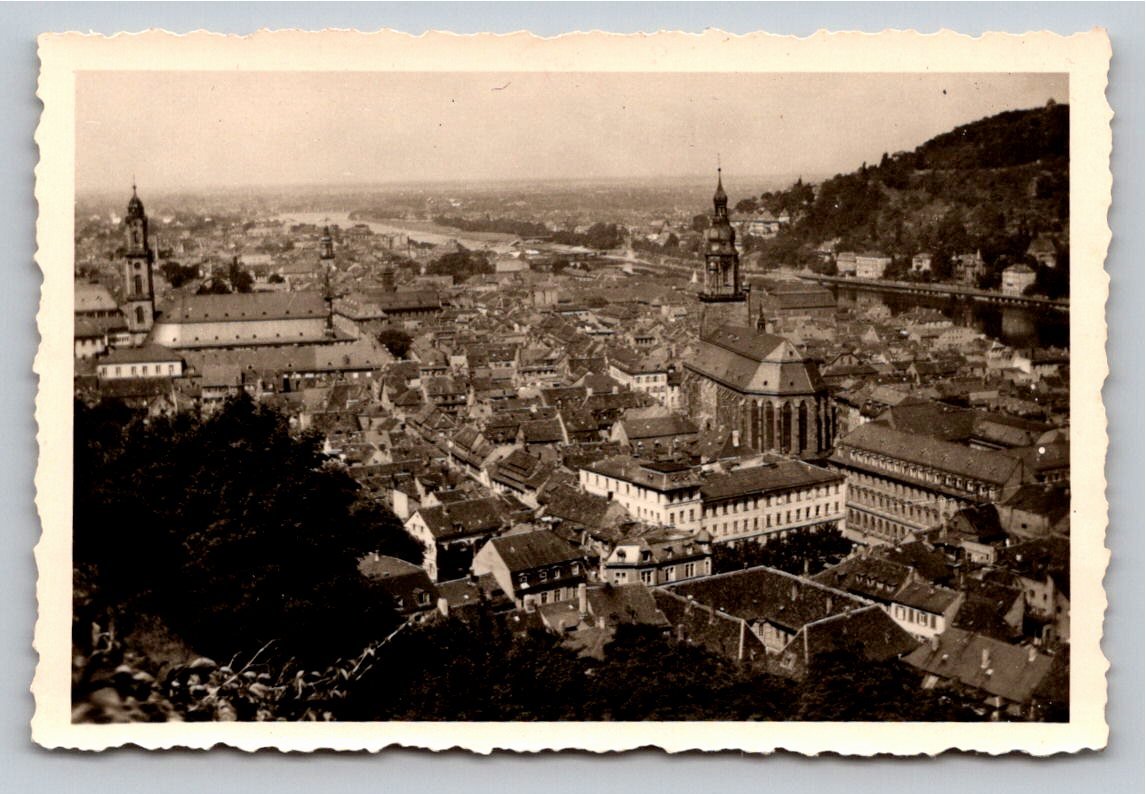
1945 Heidelberg Germany Castle Overlook City Skyline Photo
📸 Click any thumbnail to inspect Front, Back & Angles (2 Photos)
🔗 Embed / Cite This Archival Image (Free with Attribution)Get HTML Code
© USA RESELL. Bloggers, historians, and website owners may embed this image for free by copying the HTML code below (which includes the required credit link back to this page):
USA RESELL is a living historical archive. Because original artifacts are one-of-a-kind and source records change rapidly, use the button above to check live marketplace availability or locate surviving examples. As an eBay Partner, we may earn a commission on qualifying purchases.
Item Specifications
- City: Heidelberg
- State: Unspecified
- Country: Germany
- Era: WWII (1939-1945)
- Subject: Heidelberg Castle Overlook Heiliggeistkirche Neckar River
- Theme: History
- Category: Vintage Photography
- Format / Type: Vintage Photographs
Historical Context & Overview
Panoramic Vantage from Heidelberg Castle in June 1945
This original black-and-white print captures a sweeping view across the historic city center of Heidelberg, Germany, taken from the elevated terrace grounds of the famed Heidelberg Castle (Heidelberger Schloss). Looking northwest across the Rhine Rift Valley, the composition highlights the dense, intact urban core of the Altstadt. Dominating the skyline are the prominent Gothic and Baroque steeples of the Church of the Holy Spirit (Heiliggeistkirche) and the Jesuit Church, standing tall above a sea of gabled tile roofs that slope gently toward the waters of the Neckar River.
The visual depth of the photograph extends into the broad river plain, showing the tranquil waterway and the rolling hills that frame the northern bank. Characteristic of mid-century European photographic printing, the picture features ornate deckled edges with serrated borders, adding distinct period charm. The framing balances lush foreground foliage at the foot of the castle hill with the sweeping architectural tapestry of one of Germany's most celebrated historic university towns.
Historical Context: An Undamaged Haven in Postwar Europe
Dating to June 6, 1945, this image was created almost exactly one month after the unconditional surrender of German forces brought an end to World War II in Europe. Unlike neighboring industrial hubs such as Mannheim or Frankfurt, which suffered devastating aerial bombardment during the conflict, Heidelberg emerged largely unscathed. Its absence of heavy industry, combined with its cultural prominence and designation as a hospital center, spared its ancient monuments and baroque streets from destruction.
Following the arrival of the U.S. Army in late March 1945, Heidelberg quickly became a major headquarters and garrison center for the American military occupation in postwar Germany. Allied soldiers and personnel stationed in the European theater frequently documented the town's picturesque architecture and romantic scenery. The reverse side of this print bears an authentic period handwritten notation penned in sepia ink, reading: "View of Heidelberg Germany from the castle - 6 June 1945," anchoring the artifact precisely to the earliest weeks of Allied peace.
Physical Attributes, Paper Stock, and Collector Provenance
The photograph measures approximately 3.5 by 2.3 inches, a standard pocket-sized print format commonly favored by service members compiling personal scrapbooks or sending keepsakes home to family. Developed using traditional gelatin-silver emulsion chemistry on glossy photographic paper, the print displays rich contrast, strong shadow detail in the wooded foreground, and crisp mid-tones throughout the distant street grid.
Preservation of the artifact is exceptionally strong, presenting crisp deckled margins, an unbent surface, and minimal age-related toning. As an authentic piece of mid-1940s photojournalistic documentation, it bridges fine European topographical photography with the profound historical turning point of postwar occupation history. It offers military historians and architectural ephemera collectors an unvarnished window into Germany at the dawn of the reconstruction era.