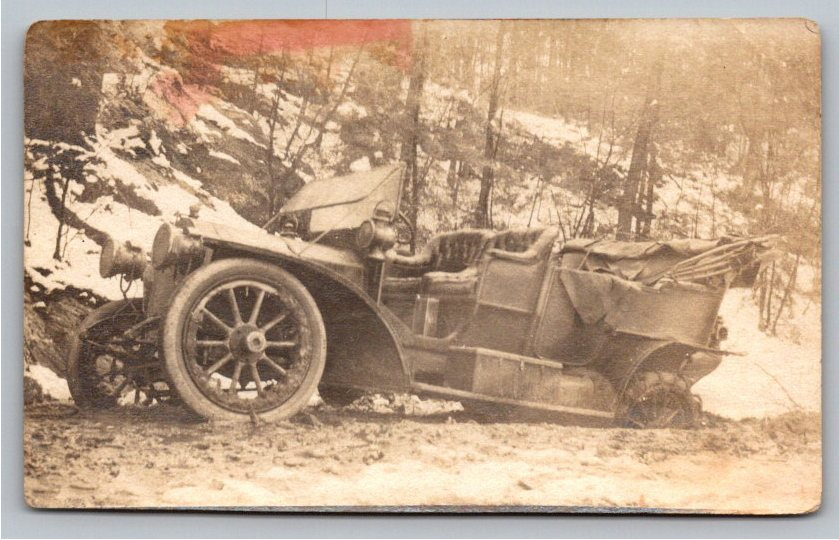
c. 1910 Packard Touring Car Stuck in Mud Real Photo Postcard
📸 Click any thumbnail to inspect Front, Back & Angles (2 Photos)
As an eBay Partner, we may earn a commission if you make a purchase.
Item Specifications
- Era: c. 1910 Brass Era
- Subject: Packard Touring Automobile
- Theme: Early Automotive & Road Conditions
- Process: Silver Gelatin Print
- Originality: Original Vintage Postcard
- Condition: Unposted with Minor Age Wear
- Category: Postcards & Ephemera
- Format / Type: Real Photo Postcards (RPPC)
Looking for Modern Alternatives?
Explore top-rated, modern Postcards & Ephemera and related historical accessories on Amazon.
Shop Postcards & Ephemera on Amazon →As an Amazon Associate, we earn from qualifying purchases.
Historical Context & Overview
The Perils of Early Motoring: A Packard Mired in Mud
During the opening decade of the twentieth century, the automobile represented the pinnacle of modern technology, luxury, and personal freedom. Yet, the rapid engineering advancements of pioneering automakers far outpaced the development of American infrastructure. This captivating original Real Photo Postcard (RPPC), dating to approximately 1910, offers an authentic look at the stark reality faced by early motorists: a prestigious Packard touring car hopelessly bogged down in deep, treacherous mud along a wilderness hillside.
In this era, Packard was heralded as one of America's premier luxury automakers, famous for its advertising tagline, "Ask the Man Who Owns One." Engineered with robust multi-cylinder engines, high-grade steel frames, and meticulous craftmanship, a Packard was built to endure rugged terrain. However, as this photograph dramatically illustrates, even elite engineering was occasionally no match for the primitive, unpaved backcountry roads of early 1900s America.
Pioneering Roads and the Mud Standard
Prior to the establishment of the Lincoln Highway in 1913 and the federal road expansion programs of the 1920s, outside of major metropolitan centers, American roads were largely rutted dirt tracks, wagon trails, or logging routes. Spring thaws, heavy rains, and winter slush turned these passages into thick quagmires. "Getting stuck in the mud" was not merely an occasional inconvenience; it was a central cultural theme of early motoring, giving rise to local towing services using horse teams and inspiring countless popular songs and comedy routines of the day.
Real Photo Postcards from this period captured these authentic moments with unscripted realism. Kodak's introduction of postcard-sized film rolls allowed everyday motorists and itinerant photographers to convert personal photographs directly into mailable postcards, creating invaluable visual records of early transportation history.
Visual Analysis of the Vehicle and Scene
This image provides a extraordinary study in Brass Era automotive details. The vehicle featured is a large open touring car—a classic body style of the c. 1908–1912 period—equipped with heavy wooden spoke artillery wheels. The rear wheels are sunk nearly hub-deep into wet earth, while the front driver's side wheel tilts precipitously into a slushy ditch. Noticeable features include the prominent brass headlamps, brass side lamps mounted near the cowl, a folded canvas top, and rich button-tufted leather seating across the open passenger compartment.
The backdrop reveals a rocky, forested incline lightly dusted with snow or frost, underscoring the challenging environmental conditions the driver attempted to navigate. A side-mounted running board box, designed to hold batteries or tools, sits perched just inches above the mire, highlighting the extreme angle at which the vehicle has come to rest.
An Enduring Artifact of the Good Roads Movement
Photographs like this one played an unexpected role in American history. As auto ownership expanded among the affluent and middle classes, public frustration over impassable rural roads mobilized the "Good Roads Movement"—a nation-wide political push led by cycling organizations and early automobile clubs demanding paved transcontinental highways. Today, this vintage silver gelatin print stands as a compelling historical primary source, documenting both the raw adventurous spirit of early motoring and the formidable landscapes early drivers sought to conquer.