1900s Antique Monogram A Purple Pansies Happy Birthday Postcard
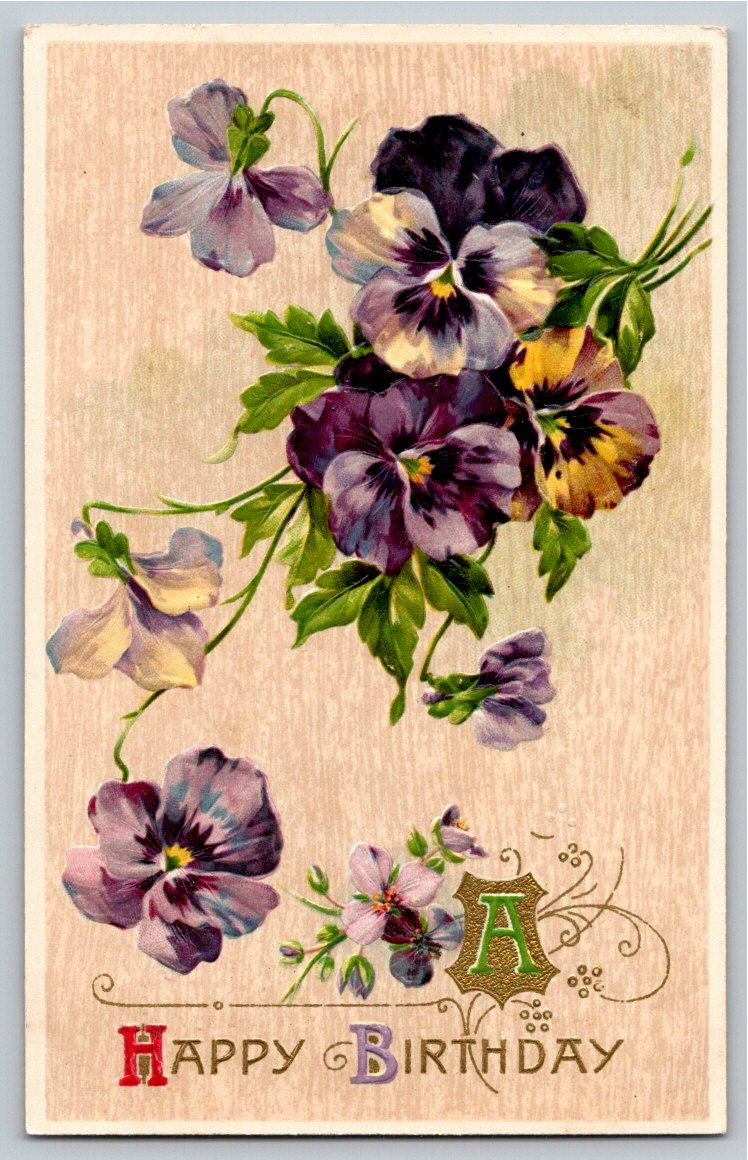
📸 Click any thumbnail to inspect Front, Back & Angles (2 Photos)
As an eBay Partner, we may earn a commission if you make a purchase.
Item Specifications
- Era: Divided Back (c. 1907-1915)
- Origin: Germany
- Subject: Purple Pansies & Monogram A
- Theme: Happy Birthday Greeting
- Finish: Embossed with Gilding
- Originality: Original Vintage
- Category: Postcards & Ephemera
- Format / Type: Vintage Postcards
Looking for Modern Alternatives?
Explore top-rated, modern Postcards & Ephemera and related historical accessories on Amazon.
Shop Postcards & Ephemera on Amazon →As an Amazon Associate, we earn from qualifying purchases.
Historical Context & Overview
During the Golden Age of Postcards—roughly spanning from 1902 through the outbreak of World War I—sending vibrant greetings through the post became a global phenomenon. Beyond mere correspondence, these miniature works of art carried deep emotional sentiments, intricate craftsmanship, and rich cultural symbolism. This exquisite early 1900s birthday postcard featuring an embossed arrangement of purple pansies and a gilded monogram "A" serves as a premier example of Edwardian social tradition and German printing mastery.
Floriography and the Language of the Pansy
In the 19th and early 20th centuries, floral illustration was rarely purely decorative. Through the popular code of floriography, or the "Language of Flowers," every blossom conveyed a hidden sentiment. The word "pansy" originates from the French pensée, meaning "thought" or "remembrance." Consequently, presenting someone with pansies conveyed the message that they were fondly held in the sender's thoughts.
When combined with a birthday wish, purple pansies represented thoughtful affection, admiration, and nobility. The deep violet and lavender tones on this card are contrasted with sunny yellow centers and soft green foliage, layered across a faux wood-grain texture that gives the composition a rustic yet refined elegance.
The Mastery of German Lithography
A hallmark of high-end vintage postcards from this era is their country of origin. The reverse side of this card proudly bears the imprint "Printed in Germany." Before 1914, German lithographers were undisputed world leaders in color printing, utilizing complex chromolithographic techniques that applied ink in up to twelve distinct layers.
Furthermore, German manufacturers perfected heavy multi-die embossing. The raised relief on this card gives substantial three-dimensional texture to the pansy petals and leaf veins. To elevate the design further, metallic gold accents surround the stylized initial "A," framed in a protective crest that catches the light naturally.
Monogram Personalization in Edwardian Culture
Monogrammed greeting cards represented a subtle form of luxury during the Edwardian era. Rather than selecting a generic generic floral greeting, a sender could choose a card tailored specifically to the recipient’s first or last initial. The stylized green and gold "A" on this piece offered a bespoke touch, making the birthday greeting feel intimate and carefully considered.
Archival Details for Collectors
This original antique postcard features a divided back, a format officially authorized in the United States in March 1907 that allowed senders to write messages on the left side while reserving the right exclusively for the recipient's address. Unposted with pencil notations on the back ("Edith" and "Mina"), the piece retains crisp embossing, vivid original color saturation, and light edge wear consistent with age, making it an ideal candidate for collectors of floral art, initial cards, or early German printing history.