1950s Boys on Bicycle Mid Century Suburb Home Snapshot
📸 Click any thumbnail to inspect Front, Back & Angles (2 Photos)
🔗 Embed / Cite This Archival Image (Free with Attribution)Get HTML Code
© USA RESELL. Bloggers, historians, and website owners may embed this image for free by copying the HTML code below (which includes the required credit link back to this page):
USA RESELL is a living historical archive. Because original artifacts are one-of-a-kind and source records change rapidly, use the button above to check live marketplace availability or locate surviving examples. As an eBay Partner, we may earn a commission on qualifying purchases.
Item Specifications
- City: Unspecified
- Country: United States
- Era: Mid-Century
- Subject: Boys Riding Bicycle
- Theme: Americana Domestic and Family Life Transportation
- Year of Production: 1958
- Category: Vintage Photography
- Format / Type: Snapshots
Historical Context & Overview
Suburban Freedom and Mid-Century Youth
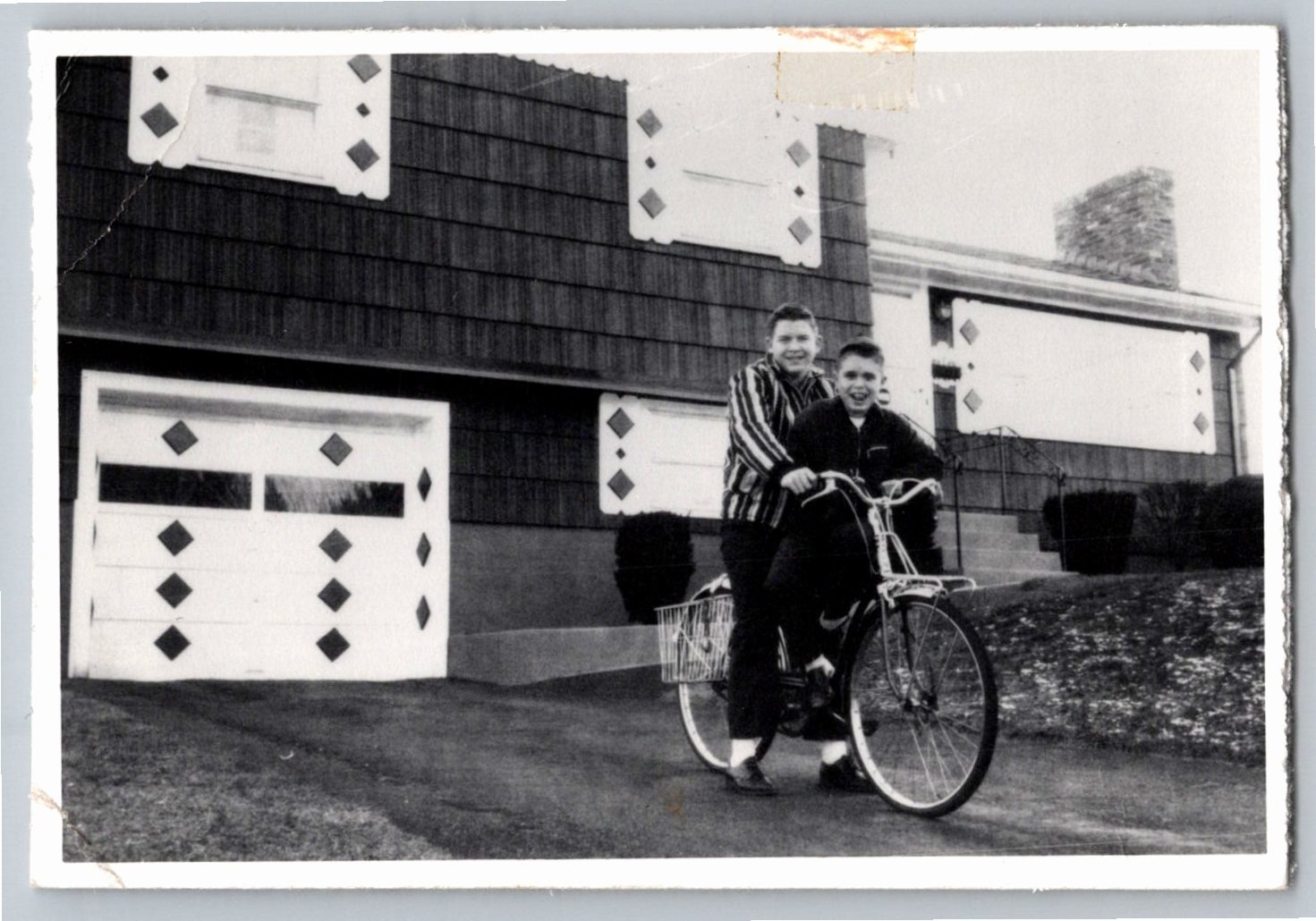
This authentic black-and-white gelatin silver photograph presents an iconic vignette of postwar American neighborhood life, dating to circa 1958. Captured on a paved residential driveway, the scene centers on two smiling young boys riding double on a single balloon-tire cruiser bicycle. The older youth stands firmly behind the handlebars wearing a bold vertical-striped cardigan jacket and dark trousers, steering with focused confidence. Perched precariously yet happily on the top crossbar sits his companion, whose exuberant open-mouthed expression radiates pure childhood adventure.
The bicycle itself serves as a tangible marker of postwar design and utilitarian fun. Fitted with substantial pneumatic tires, swept-back cruiser handlebars, an integrated front carrier rack, and a sturdy woven wire basket mounted over the rear fender, the two-wheeler represents the quintessential transportation of American adolescents in the 1950s. Whether running household errands, carrying sports gear, or ferrying a sibling down the block, these robust steel-frame bicycles offered suburban youth an unprecedented degree of neighborhood mobility and independence.
Mid-Century Residential Architecture and Diamond Accents
Beyond the engaging human subjects, the composition provides a remarkable documentary view of mid-century domestic architecture. Rising in the background is a split-level or raised-ranch family dwelling clad in textured horizontal wood shakes or shingle siding. A substantial brick chimney punctuates the roofline, while a single-car tuck-under garage anchors the lower level. The property's design exemplifies the residential building boom that reshaped suburbs across the United States throughout the 1950s, creating neighborhoods tailored specifically for young growing families.
Particularly striking are the coordinated exterior details applied to the home's facade. Symmetrical diamond accents decorate the garage door panels, the upstairs window shutters, and the framework flanking the broad picture window. These geometric motifs were hallmark decorative flourishes of late 1950s modern design, introducing stylish contemporary rhythm to traditional wood-sided residential construction. Combined with neatly edged lawn banks and foundational shrubbery, the architecture frames the boys in an unmistakable mid-century suburban landscape.
Physical Attributes, Developing Technique, and Condition
Measuring approximately 4.6 inches by 3.1 inches, this print was produced using traditional silver gelatin chemistry on medium-weight glossy photographic paper. The vertical edges feature delicate deckled scalloping, an ornamental border treatment executed by automated rotary trimming blades commonly utilized by commercial photo finishing labs during the late 1950s. The reverse remains unprinted and entirely blank white photographic stock, confirming its status as a genuine private family album print rather than a commercial card or promotional picture.
The photograph remains in good vintage condition, exhibiting honest handling characteristics typical of cherished personal ephemera. Faint cellophane adhesive residue and light surface toning are visible along the top center margin from historic mounting, accompanied by minor corner bumping, gentle edge wear, and subtle tonal silver mirroring visible under direct raking light. As an untouched primary document, it offers collectors of vernacular photography and 20th-century Americana an evocative, tangible record of postwar childhood.