Vintage 1950s Rooftop Snapshot Eerie Distorted Face Oddity
📸 Click any thumbnail to inspect Front, Back & Angles (2 Photos)
🔗 Embed / Cite This Archival Image (Free with Attribution)Get HTML Code
© USA RESELL. Bloggers, historians, and website owners may embed this image for free by copying the HTML code below (which includes the required credit link back to this page):
USA RESELL is a living historical archive. Because original artifacts are one-of-a-kind and source records change rapidly, use the button above to check live marketplace availability or locate surviving examples. As an eBay Partner, we may earn a commission on qualifying purchases.
Item Specifications
- Type: Photograph
- Original/Licensed Reprint: Original
- Image Color: Black and White
- Production Technique: Gelatin-Silver Print
- Material: Paper
- Finish: Glossy
- Category: Vintage Photography
- Format / Type: Snapshots
Historical Context & Overview
Mid-Century Rooftop Scene with a Surreal Anomaly
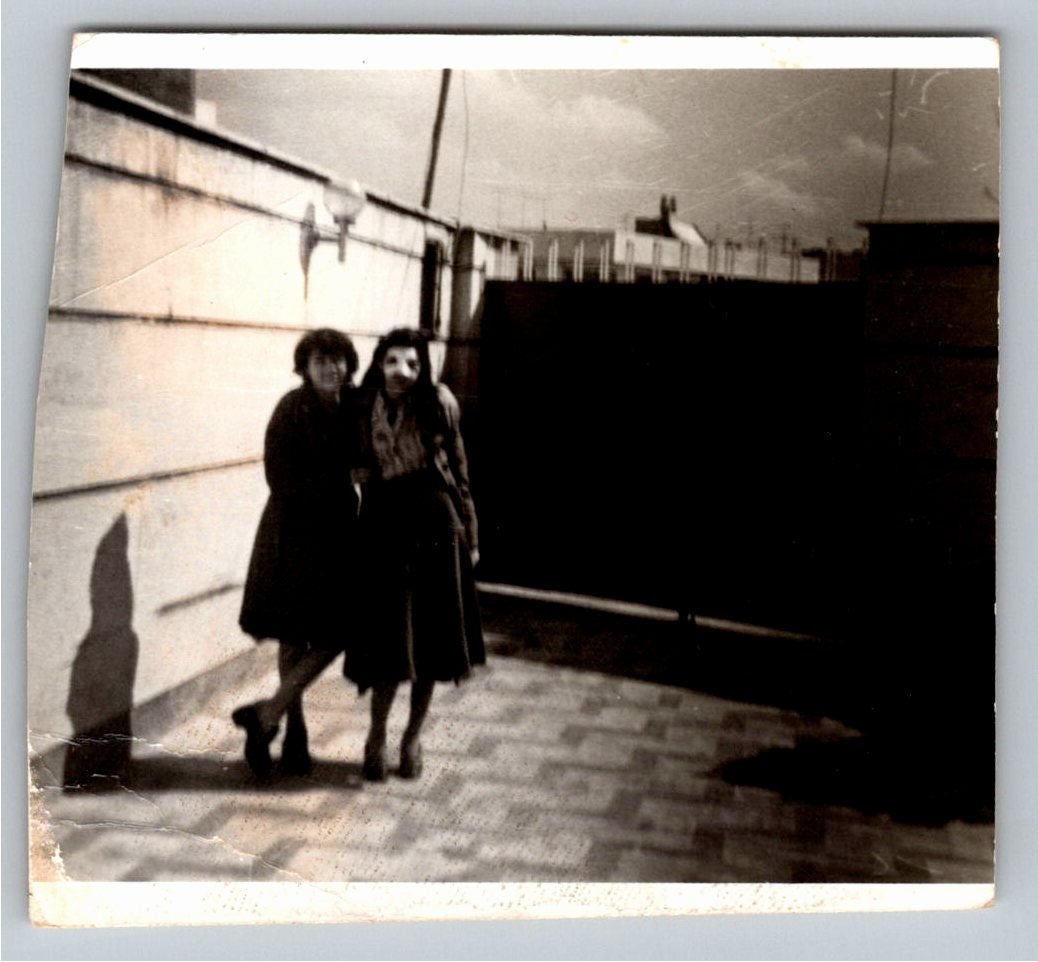
Dating to circa the early 1950s, this compelling vintage black-and-white snapshot depicts two women standing side-by-side upon an open-air rooftop patio or walled terrace. Both subjects are styled in quintessential post-war fashion, wearing tailored dark overcoats and mid-length skirts typical of mid-century everyday attire. They lean affectionately against one another before a paneled concrete wall, their relaxed stance framed by patterned paving stones beneath their heels, dramatic angled sunlight, and the architectural silhouette of urban roofs and utility fixtures stretching into the pale sky behind them.
What transforms this domestic moment into an extraordinary collectible is the striking visual distortion centered on the figure to the right. While the woman on the left gazes outward with recognizable, pleasant facial features, her companion's face is obscured by an unsettling, mask-like smear. This localized blur creates a spectral, uncanny impression that immediately draws the eye, turning a casual snapshot of post-war camaraderie into an arresting work of unintentional surrealism.
The Mechanics of Accidental Vernacular Oddities
During the 1940s and 1950s, snapshot culture exploded across North America as lightweight roll-film cameras, such as Kodak Brownies and folding viewfinders, became staple household items. These consumer-grade mechanical shutter systems operated at fixed, relatively slow exposure speeds. If a subject shifted rapidly, sneezed, or tilted her head during the exact millisecond the shutter curtain snapped open, the resulting motion blur produced unexpected optical illusions that could neither be previewed nor corrected until the film roll was developed at the local drugstore.
Today, inadvertent anomalies of this caliber occupy a celebrated niche within the collecting sphere known as vernacular photography or accidental art. Collectors of strange Americana, ghost-lore photography, and folk surrealism actively hunt for authentic mid-century darkroom blunders, double exposures, and motion artifacts. Rather than devaluing the image, this natural mechanical mishap lends the print a uniquely haunting aesthetic that pre-dates digital manipulation by half a century.
Physical Attributes, Archival Condition, and Collector Significance
This authentic period artifact measures approximately 3.2 by 2.9 inches, a classic square-format footprint consistent with standard 120 or 620 roll film developed during the mid-twentieth century. The image is rendered as a traditional silver gelatin print on glossy photographic paper stock. The reverse side remains completely blank and unprinted, free of commercial backstamps, publisher notations, or family inscriptions, firmly establishing its provenance as a privately exposed, one-of-a-kind personal camera negative.
In terms of physical preservation, this vintage print survives in fair to good condition, retaining crisp tonality and rich contrast in both the highlights and shadowed folds of the figures' coats. The print displays authentic handling signs earned over decades of personal album storage, including faint age toning, mild surface rubbing, and visible horizontal creasing across the lower margin and bottom-left corner. It remains a singularly captivating specimen for curators of historic photo oddities and mid-century urban culture.