1930s Office Scene Man on Rotary Phone Vintage Snapshot
📸 Click any thumbnail to inspect Front, Back & Angles (2 Photos)
🔗 Embed / Cite This Archival Image (Free with Attribution)Get HTML Code
© USA RESELL. Bloggers, historians, and website owners may embed this image for free by copying the HTML code below (which includes the required credit link back to this page):
USA RESELL is a living historical archive. Because original artifacts are one-of-a-kind and source records change rapidly, use the button above to check live marketplace availability or locate surviving examples. As an eBay Partner, we may earn a commission on qualifying purchases.
Item Specifications
- City: Unspecified
- Country: United States
- Era: 1930s
- Subject: Office Business Telephone
- Theme: Americana Occupational Domestic and Family Life
- Year of Production: 1935
- Category: Vintage Photography
- Format / Type: Snapshots
Historical Context & Overview
Visual Overview of a Depression-Era Workplace
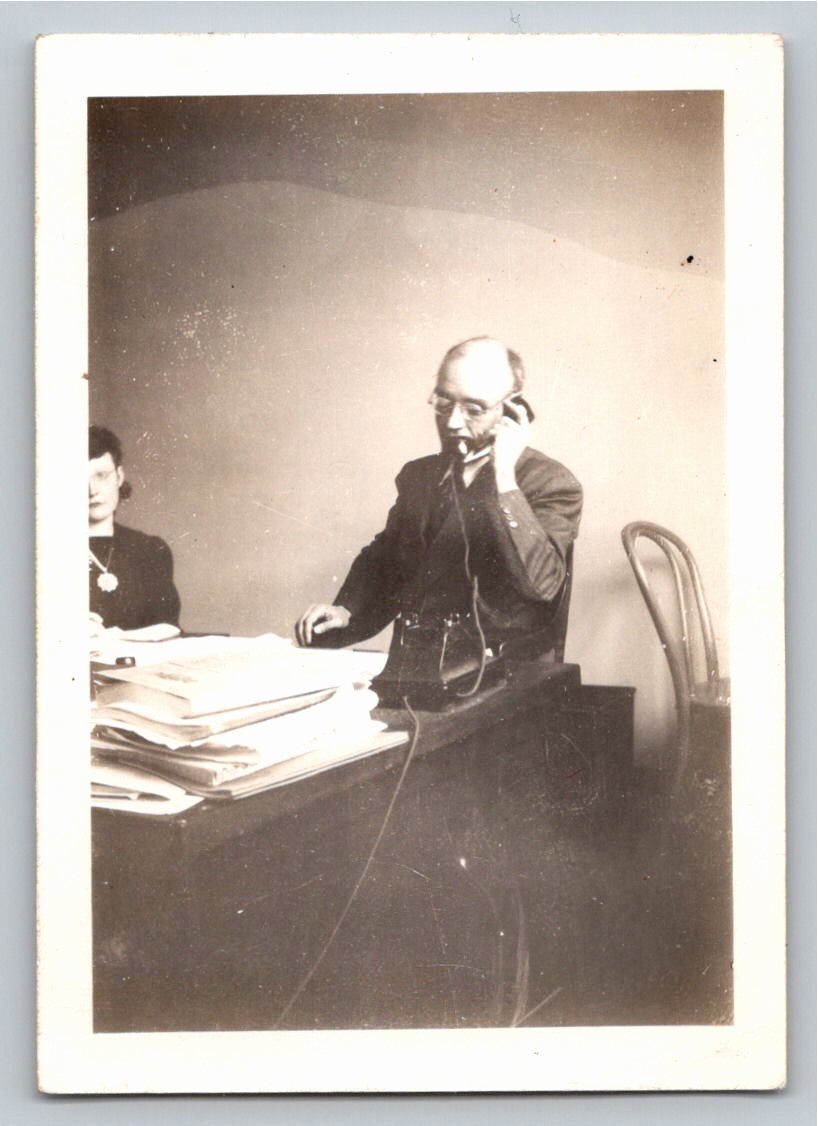
This evocative candid photograph offers a rare window into everyday American corporate life during the mid-1930s. The composition centers on a professional gentleman seated purposefully behind a heavy wooden desk, deeply engaged in conversation via an early cradle-style rotary telephone. Outfitted in a tailored dark two-piece suit with round wire spectacles, he embodies the focused diligence required of clerical workers and business managers navigating the economic realities of the interwar era. Behind him sits a female colleague or administrative assistant, partly framed beside a towering accumulation of legal files, bound folders, and loose administrative documents.
The interior setting is illuminated by soft, natural ambient room light combined with indoor directional lighting, casting gentle shadows across the plain office walls. Beside the executive workspace rests a classic bentwood side chair, a fixture of early-to-mid twentieth-century institutional decor. The stark realism of the shot, free from commercial studio staging, provides an unvarnished glimpse into the tactile density of an analog administrative office before modern digital filing or automated data systems existed.
The Material Culture of 1930s Telephony and Administration
During the 1930s, the desk telephone transformed from a specialized communication apparatus into the indispensable nerve center of American commerce. The telephone shown here reflects the iconic Western Electric cradle telephone designs of the decade, featuring a heavy molded receiver and a rotary dial mechanism positioned atop an angled base. Business operations relied entirely on direct telephonic correspondence and meticulous physical paper trails, as reflected by the precarious paper mounds crowding the desk's edge. Every transaction, ledger notation, and client briefing required physical documentation, which explains the sheer volume of dossiers surrounding the workers.
The reverse side of this print contains no personal signatures or extensive captions, but features an authentic vintage darkroom production ink stamp: "571 F". Such alphanumeric markings were commonly applied in commercial photo-finishing laboratories to track customer orders, batch runs, and negative matching numbers. This discrete stamp anchors the print to standard mid-1930s photo processing practices, affirming its origin as a private vernacular snapshot rather than a staged corporate promotional release.
Format, Paper Condition, and Vernacular Significance
Preserved on classic single-weight photographic paper with a smooth glossy finish, the print measures approximately 2.4 by 3.5 inches, a beloved portable snapshot format of the period. The image retains rich contrast with well-balanced black tones, soft sepia-tinged mid-tones, and luminous white margins that neatly frame the composition. The fine wood grain of the desk, the crinkle of the stacked folios, and the tailored wool of the man's coat remain strikingly distinct, exhibiting excellent focus and depth of field.
In terms of preservation, this vintage print remains in very good historical condition, exhibiting neatly preserved borders, crisp corners, and only negligible handling wear commensurate with its age. Free of destructive punctures, tape remnants, tears, or severe creases, it represents an outstanding archival artifact for enthusiasts of vernacular photography, vintage telecommunications, and early twentieth-century American occupational history.