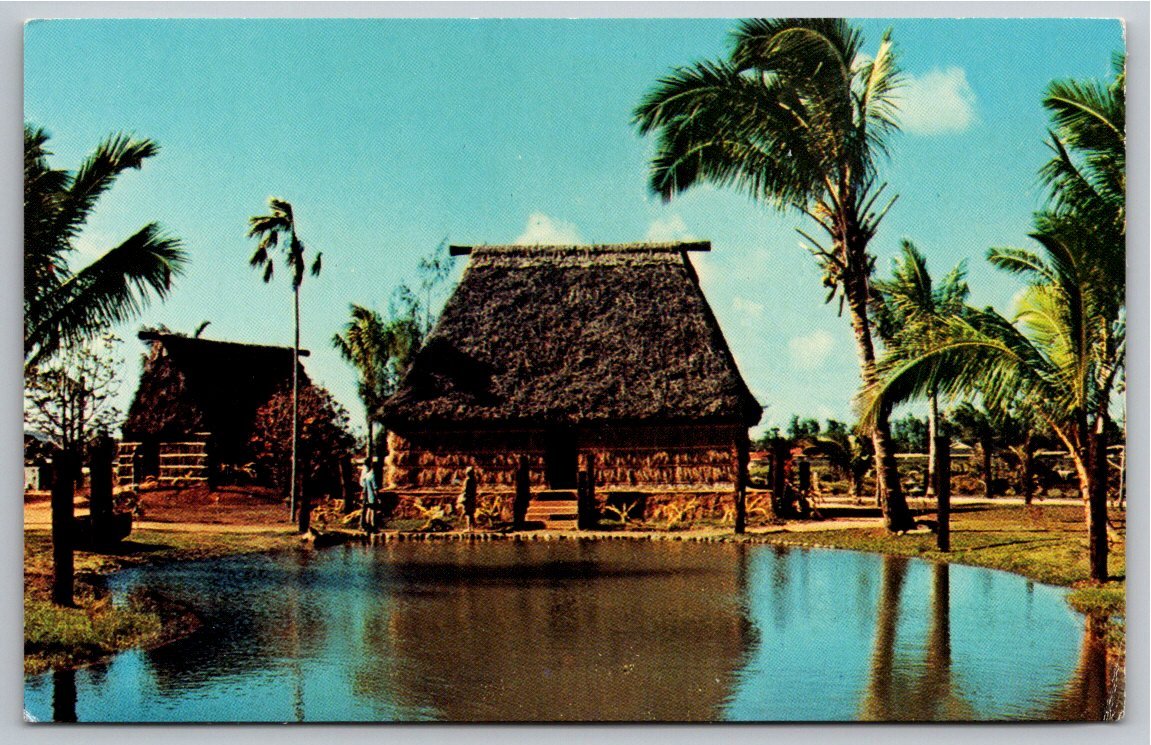
Polynesian Cultural Center Hawaii Postcard: Fijian Chief House
📸 Click any thumbnail to inspect Front, Back & Angles (2 Photos)
As an eBay Partner, we may earn a commission if you make a purchase.
Item Specifications
- Era: 1960s
- Location: Lāʻie, Oahu, Hawaii
- Publisher: Polynesian Cultural Center
- Subject: Fijian Village Chiefs House
- Condition: Unposted / Unused
- Theme: Pacific Island Architecture & Tourism
- Category: Postcards & Ephemera
- Format / Type: Vintage Postcards
Looking for Modern Alternatives?
Explore top-rated, modern Postcards & Ephemera and related historical accessories on Amazon.
Shop Postcards & Ephemera on Amazon →As an Amazon Associate, we earn from qualifying purchases.
Historical Context & Overview
Mid-Century Hawaiʻi and the Architectural Heritage of Lāʻie
In October 1963, the Polynesian Cultural Center opened its doors on forty-two acres along Oahu’s northern shore in Lāʻie, Hawaii. Designed as a living museum and cultural preserve, the center aimed to educate visitors on the rich traditions, crafts, and architecture of six distinct Pacific Island cultures: Hawaii, Samoa, Aotearoa (New Zealand), Fiji, Tahiti, and Tonga. Beyond its educational mission, the center served as a critical source of financial support for students attending the adjacent Church College of Hawaii (now Brigham Young University–Hawaii).
During the 1960s commercial jet travel boom, Hawaii experienced an unprecedented influx of mainland tourists eager to witness authentic representations of South Pacific life. Official postcards published directly by the Polynesian Cultural Center became prized keepsakes, documenting the elaborate artisan-built structures created by native craftsmen who used traditional materials and techniques transported directly from their home islands.
The Fijian Chief’s House: Symbolism in Thatch and Timber
Among the center’s most striking features was the Fijian Village, dominated by the commanding chief's house—traditionally known as a Vale Levu. As noted in the original reverse caption of this vintage postcard, the chief’s dwelling stands deliberately aloof from the surrounding structures in the village. In traditional Fijian society, spatial orientation directly reflected social hierarchy; the chief’s residence occupied a prominent, elevated, or set-apart position to reinforce sacred authority, leadership, and protection over the community.
Constructed with steep, dramatically pitched roofs thatched with local grass and bound together with intricately lashed coconut husk fiber rope (magimagi), these structures were engineered to withstand torrential tropical rains while facilitating high air circulation. The visual impact of this massive thatched gable reflected across the calm waters of the center's winding artificial lagoon offered tourists an iconic photograph, showcasing both human craftsmanship and natural harmony.
Visual Nostalgia and Mid-Century Postcard Ephemera
Printed on high-gloss chrome postcard stock, this vintage piece exemplifies mid-century color photography with saturated sky blues, lush emerald palms, and golden thatched tones. The back retains its clean, unposted layout featuring the center's vintage double-hulled canoe crest and stylized "ALOHA to:" greeting section, adding immense value for paper ephemera collectors.
For collectors of Hawaiiana, vintage travel memorabilia, and Oceanic cultural artifacts, this postcard represents more than a simple souvenir. It offers a pristine snapshot of mid-20th-century cultural preservation, capturing an early chapter in Hawaii's heritage tourism industry and preserving the timeless architectural legacy of Fiji's revered chieftain heritage.