1918 WWI US Army Doughboys Field Camp Wagons Photo - World War I
📸 Click any thumbnail to inspect Front, Back & Angles (2 Photos)
🔗 Embed / Cite This Archival Image (Free with Attribution)Get HTML Code
© USA RESELL. Bloggers, historians, and website owners may embed this image for free by copying the HTML code below (which includes the required credit link back to this page):
USA RESELL is a living historical archive. Because original artifacts are one-of-a-kind and source records change rapidly, use the button above to check live marketplace availability or locate surviving examples. As an eBay Partner, we may earn a commission on qualifying purchases.
Item Specifications
- City: Unspecified
- Country: United States
- Era: World War I (1914-1918)
- Subject: Military Soldiers Horses Supply Wagons
- Theme: Militaria Americana History
- Year of Production: 1918
- Category: Vintage Photography
- Format / Type: Snapshots
Historical Context & Overview
Field Logistics and Daily Life in a World War I Camp
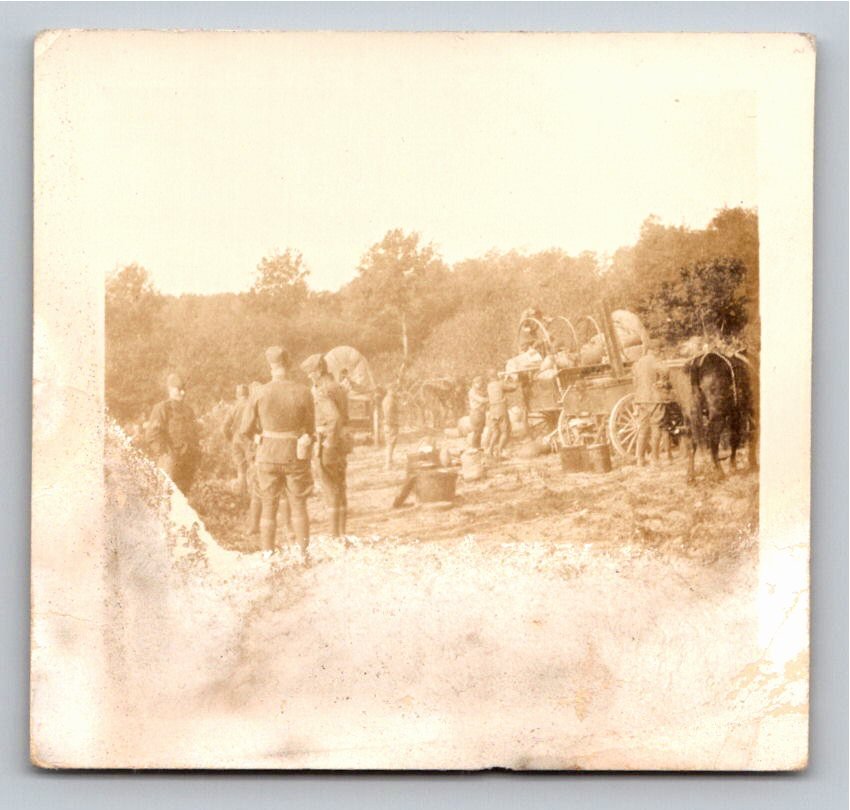
This original vintage snapshot presents an authentic, unvarnished look at an active United States Army encampment during the First World War. Captured in warm sepia tones, the image centers on doughboys wearing regulation field service uniforms, wool breeches, and campaign hats as they carry out daily camp routines. Around them stand traditional horse-drawn supply wagons loaded with canvas rolls, field gear, and provisions, offering an intimate perspective on military organization in an open countryside setting.
The scene captures both the camaraderie and the practical responsibilities inherent to early 20th-century campaigning. In the foreground and midground, enlisted men gather near cook pots, water buckets, and equipment chests while draft horses remain hitched to high-seated transport wagons. Wooden-spoked wheels and heavy canvas tarpaulins underscore the rustic nature of mobile encampments before full mechanization reshaped front-line supply chains.
Equine Transport and the Backbone of Doughboy Supply Lines
While the First World War marked the rapid emergence of motorized trucks, tanks, and aerial reconnaissance, draft animals remained the indispensable foundation of frontline logistics. Transport wagons such as the standard Army escort wagons seen here were vital for navigating unimproved dirt tracks, shell-cratered terrain, and deep mud where early combustion engines routinely foundered. Quartermaster units relied heavily on teamsters and enlisted handlers to keep supplies flowing to forward elements.
Photographs like this one illustrate the extensive labor required merely to sustain soldiers in bivouac. Beyond military maneuvers, doughboys devoted countless hours to animal husbandry, equipment repair, mess preparation, and cargo distribution. The casual grouping of figures suggests a momentary lull in transit or the setup of a temporary waypoint, highlighting an unposed reality rarely depicted in formal studio portraits.
Print Characteristics, Condition, and Archival Significance
Produced as an authentic gelatin silver print on matte photographic paper stock, this snapshot measures approximately 2.5 by 2.4 inches. The reverse remains unprinted and blank save for a faint, period numerical ink stamp situated near the lower right corner, typical of commercial darkroom processing or soldier album numbering. Its compact dimensions reflect the portable roll-film cameras frequently carried unofficially by servicemen during the era.
Surviving over a century, the print exhibits genuine historical character. Natural corner softening, light edge handling, and subtle exposure fading along the lower left quadrant are visible, attesting to its original handling and private preservation. As an authentic piece of military Americana, this artifact provides collectors and historians with a compelling window into the daily operational realities of the American Expeditionary Forces.